


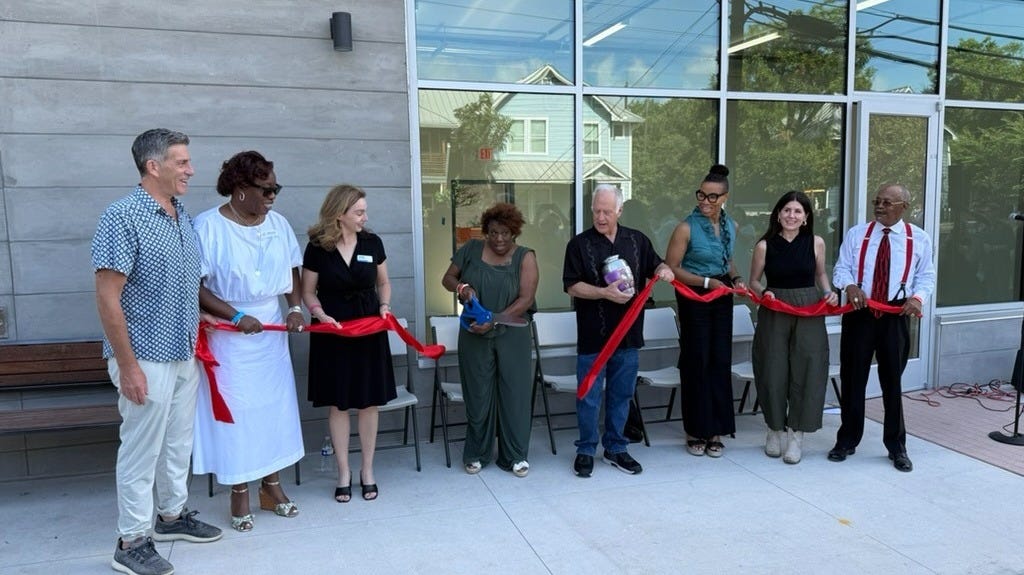
Scottie Ivory didn’t live to see the completion of the building that bears her name. The Ivory is the first of its kind in Austin: an all-electric, no parking, owner-occupied condo building with 75% of the homes designated as workforce housing and priced below market. At the June ribbon-cutting, the stories shared by Scottie’s friends, family, and members of her community spoke to a woman of character, resolve, and tremendous personal agency who spent her nearly 96 years fighting against the crime and blight that had transformed a vibrant neighborhood into a ghetto. Scottie’s pastor acknowledged the tremendous resolve it took to get The Ivory off the ground, invoking God’s protection for all those who made it happen.
As Scottie’s family and friends invited those gathered to join them in singing the old hymn “In the Garden,” I wondered why it seems like it takes an act of God to build affordable housing on a vacant lot in one of the most desirable neighborhoods in Austin.
Central East Austin was once the center of Black life in segregated Austin. The end of segregation was a moral necessity, but it also allowed residents to move beyond the confines of what the city once designated as the “Negro District.” The closure of the segregated high school and the forced busing of Black students to better-resourced white schools further eroded the ties locals had to the neighborhood. Central East Austin fell into decline, and buildings on the once bustling commercial stretches of 11th and 12th Streets burned to the ground and remained vacant. Criminals moved in as long-time residents moved out, and the corner of 12th and Chicon Streets became an open-air drug-dealing and prostitution market. In the past twenty-five years, rising real-estate prices elsewhere in Austin enticed new residents to cross the former racial barrier, driving up prices in East Austin. The scars and memories of that era of disinvestment and decay remain as a scattering of vacant lots, Black churches whose congregations drive in on Sundays, and murals celebrating the neighborhood’s past—while newer million-dollar homes sprout in between and new businesses fill storefronts serving a more recent clientele.
The Ivory is both an investment in the neighborhood’s future and a reminder of its past.
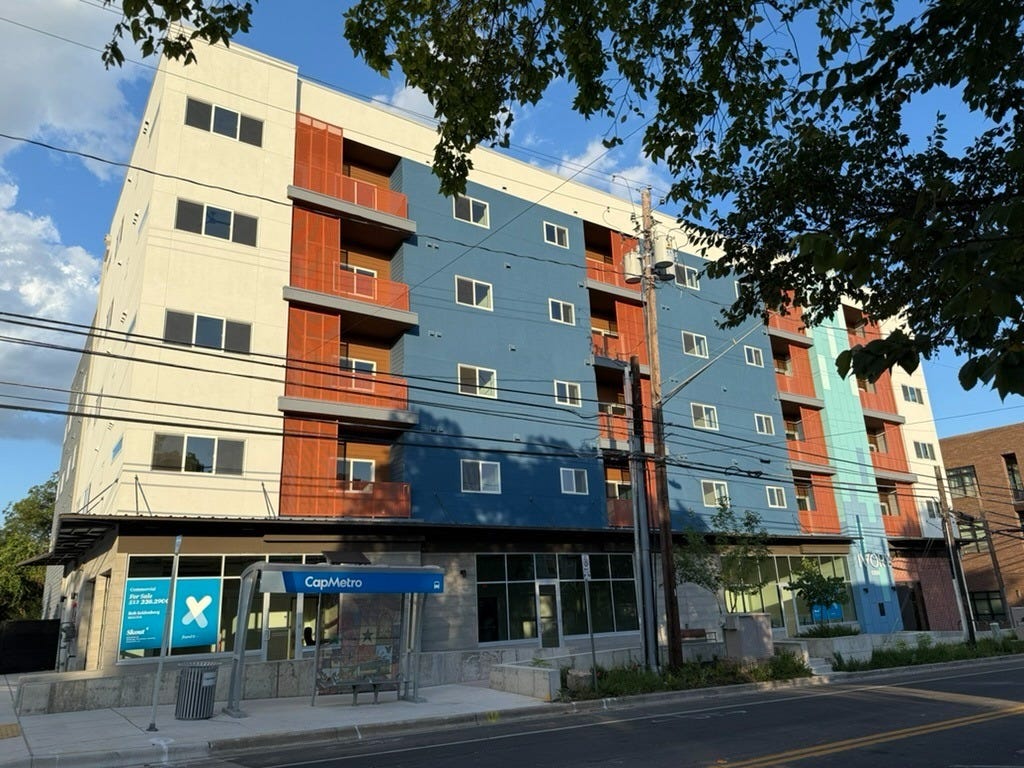
It’s remarkable that, out of that dysfunction, this building exists at all. The Ivory rises just a couple blocks from my house in Central East Austin, part of a peculiar complex that includes two other affordable condo buildings, called The Chicon Phase 1 (The Ivory is officially The Chicon Phase 2). Of its 53 condos, 40 are priced at or below 70% of the area median family income, with the one- to two-bedroom workforce homes priced in the $215k to $250k range—and they must be kept affordable for 99 years.1 Solar power will cover 90% of the building’s demand. The Ivory has one handicapped parking spot but no other on-site parking; residents will be able to share two electric vehicles, and each will also receive an e-bike on closing. CapMetro, the transit agency, also upgraded the bus stop at the base of the building to include a shelter with a commemorative mural. City officials, including the mayor and the Deputy CEO of CapMetro, emphasized the role of mobility and utilities in addressing affordability issues.
The Ivory extends an emerging mixed-use corridor. Phase 1, in addition to 20 units of workforce housing, brought retail spaces that are now occupied by a vegan café, an Urban Lagree studio, a French pastry shop, a pet store, and a bougie boutique that have brought vitality to the neighborhood since the buildings opened in 2018—even if they are not quite reflective of the neighborhood’s heritage. The Ivory has three commercial units, including a restaurant space, that me and my neighbors are excited to see occupied.
The Ivory benefited from a unique set of individuals, policies, and circumstances. The land for Phases 1 and 2 was assembled beginning in 2012 by the Chestnut Neighborhood Revitalization Corporation, a nonprofit formed twenty years ago to develop affordable housing for the neighborhood. As a designated Community Land Trust, CNRC is exempt from city property taxes, which supports its mission to provide long-term affordable ownership units. The project itself received a variety of public and nonprofit grants and financing, including $5.7 million in loans from the Austin Housing Finance Corporation, $4.3 million in funding from a tax increment reinvestment zone, and $14.7 million in pre-development financing and construction loans from Capital Impact Partners.
But the project would not have been possible at all without a density bonus program called Affordability Unlocked. In exchange for creating “permanent” affordable units, the program exempts projects from setbacks, “compatibility” height limits, and parking minimums.2 These benefits not only allowed The Ivory to be a full two stories higher than the three-story Phase 1 buildings, but also increased the number of potential units from 15, of which only 6 would have been affordable. In other words, the program unlocked an additional 34 affordable units and 38 new homes in total. The compatibility exemption is telling: when Phase 1 was built, these height limits—which Austin City Council has since reformed—suppressed the height of the buildings as they got closer to single-family homes. If you look at the side profile of the Phase 1 buildings, you can see the “step up” in height from the single-family-home-adjacent rear to the unrestricted street, while Phase 2 rises straight up at the setback line. The stepped shape of the Phase 1 buildings traces the outline of all the housing Austin made illegal to build.
And that’s sort of the crux of it: the density bonus program that made The Ivory possible is remarkably explicit about what Austin’s land development rules are locking up: affordability.
Proponents of density bonus programs argue that the market would not provide deeply affordable homes if such programs did not exist, and creating deep affordability is unquestionably difficult given the costs of land, building, and financing. Nevertheless, one reason why this is so difficult is because organic density in Austin—as is the case in so many other cities—has been suppressed for nearly a century by a rigid land development code whose purpose is to perpetuate low-density single-family housing. As I’ve argued previously, greater density in high-opportunity neighborhoods is the solution to broad-based affordability. To the extent that we suppress it through the underlying zoning, we are making housing less available and therefore less affordable overall.
But the project was complicated in other ways. The Ivory must preserve affordability for 99 years, operate almost entirely on solar power, and make car-free living possible through EVs, e-bikes, and transit. In a car-centric city and in a neighborhood where the nearest grocery store is not practically accessible without a car, it’s unclear whether those mobility alternatives will be enough to attract buyers. There’s an “everything bagel” quality to the project in that this one small building has been enlisted to advance a plethora of worthy urban policy goals all at once, none of which would have been possible without grants, subsidized public and nonprofit financing, regulatory exemptions, and years of effort. All of that delivered only 53 homes, which raises the question of whether this model can be replicated. Producing deeply affordable ownership housing on expensive land is already a complex task, but much of the complexity owes to how hard we have made building housing. Given the circumstances, it’s no wonder that success looks miraculous.
Nevertheless, ecce aedificium: behold the building.
On the sidewalk in front of The Ivory, Scottie’s family held her urn and led those assembled in singing “In the Garden.” With its provisions for long-term affordability, The Ivory will give a new generation of East Austinites the ability to stay for the long term, much like the hymn says: “And the joy we share as we tarry there / None other has ever known!” For the neighborhood at large, it heals an old wound and brings new life to a long-moribund spot, echoing East Austin’s past even as it welcomes a different future. The Ivory is undoubtedly a blessing for the neighborhood and those who will call her home—but it should not take a miracle to build affordable housing.
Per The Ivory’s website, “70% of the area’s median family income (<$65,850 for a single person, <$75,250 for two-person household and <$84,650 for a three-person household).”
Since creating Affordability Unlocked, Austin has abolished all parking mandates citywide.
Bravo! Yeah, everything bagel. Don't burden projects with too many other goals (e.g., clean energy, union labor in some places). If the main goal is more housing, then everything else should get out of the way. I do wish the climate advocacy community would sometimes take a deep breath and not insist that residential buildings esp those that are supposed to be "affordable" deploy solar. Massively cheaper to deploy utility scale solar out in W Texas and bring it in (of course, many of those same advocates balk at the new transmission lines needed to do so).
The Scottie Ivory story is genuinely moving, and Ryan's right to end on "it should not take a miracle to build affordable housing" — that line is the whole piece. What jumps out at me from the deal side: this project needed $5.7M + $4.3M + $14.7M across three separate financing sources, a regulatory density-bonus exemption, and roughly 14 years from land assembly to ribbon-cutting — to deliver 53 units, only 40 of which are actually below-market. That's not a criticism of the people who pulled it off; it's the opposite. It's proof of exactly how much institutional effort, patience, and subsidy layering the current system requires to produce what should be a routine outcome. If getting to "yes" always costs this much time and this many stacked exemptions, the model literally cannot scale to the millions of households who need it — no matter how many nonprofits like CNRC exist. The "everything bagel" critique in the comments is right, but I'd go further: the deeper problem isn't that too many goals got piled onto one building, it's that the baseline path to building anything affordable is so narrow that a project needs a decade of exceptional circumstances just to exist at all.