


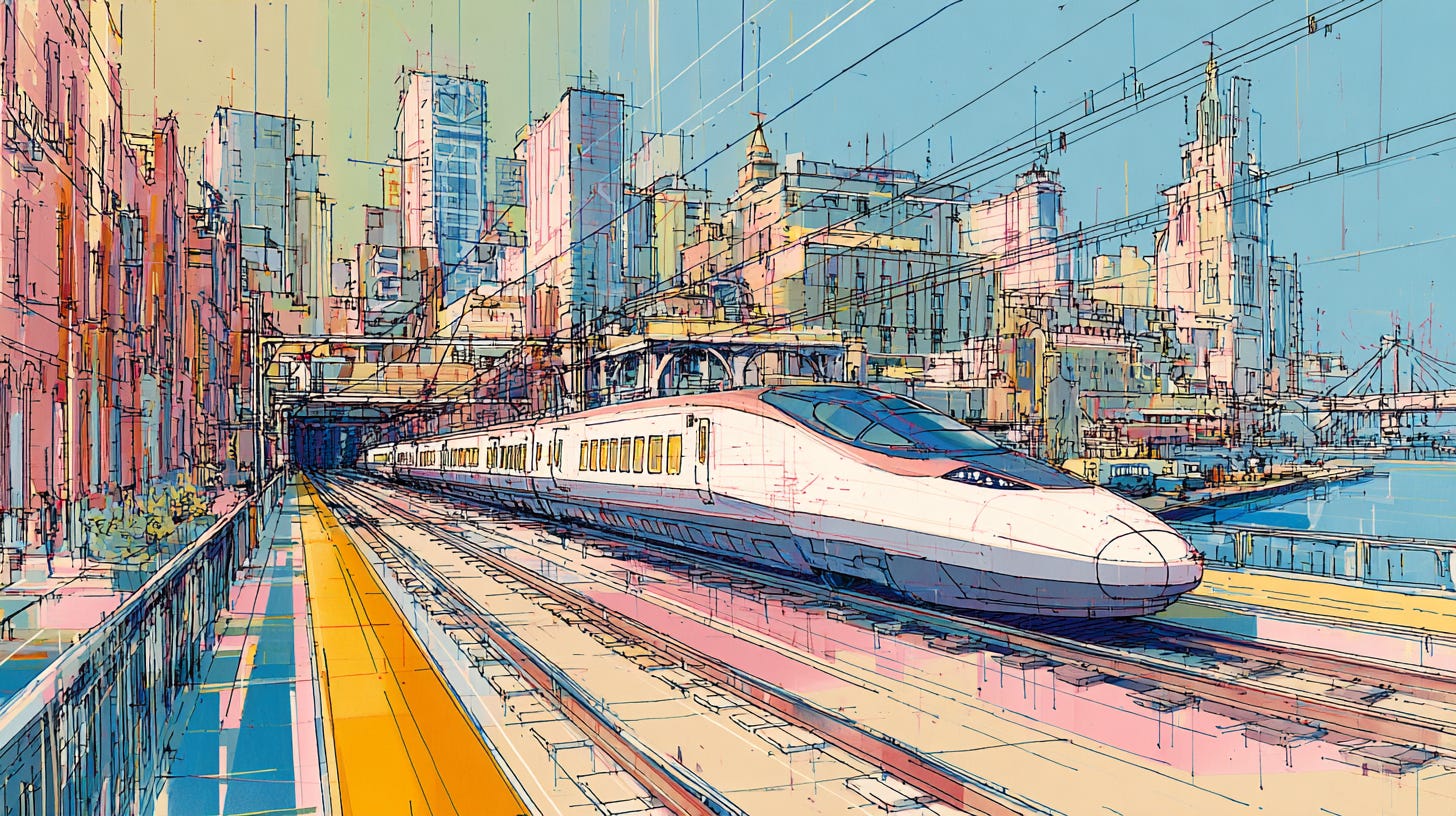
Boston’s Scollay Square teemed with morning commuters as I stepped out of the Crawford House with my overnight bag. I slipped through the ornate 1898 subway headhouse—one glance at the clock told me I had thirty minutes. Below ground, America’s oldest subway carried me one stop to Park Street, where I switched for the short ride to South Station. On this Monday morning, the train hall was bustling. The Solari board showed my train—the 9:05 AM Merchants Limited—ON TIME amid a catalog of commuter departures, including service to the northern suburbs and New Hampshire via the so-called Big Dig, with the next Merch scheduled for only a half-hour later. I grabbed a coffee and waited for the display to flap to NOW BOARDING and then headed to Track 1, where the train—one of New England Coastal’s new Kawasaki Clipper Class 700 electric sets—waited with its doors open.
I found my ticketed seat by the window as other passengers—mostly businesspeople, but some leisure travelers, too—filled in their seats. At exactly 9:05, a subtle forward motion and a soft pneumatic hiss announced our departure. The Merch picked up speed as we rolled past Dorchester’s well-preserved triple-deckers and the statelier apartment houses they had grown into, cresting 130 mph by the time we cleared the city line near Milton. From there, the train whizzed past streetcar suburbs and then sparser historic villages, as we reached our top speed of 200 mph.
The woman sitting next to me was reading the Boston Record, but the passing scenery held my attention as I sipped my coffee. The conductor entered the cabin, greeting my neighbor by name and scanning each of our phones before he moved on. “See you tomorrow,” he said to her.
At the glide-through near Providence, our speed dropped to 170 mph, but we accelerated as we exited Rhode Island and entered the longest unbroken high-speed stretch along the Connecticut coast. Long Island Sound glinted in the sun as we cruised by, while shoreline villages sped by in a blur of historic rail stations and town centers. Less than 10 miles outside New Haven, the train began to gently decelerate, entering city limits in industrial East Haven before traversing the Quinnipiac Viaduct, from which I glimpsed the mid-rise, mixed-use towers of the industrial-chic Long Wharf waterfront. We pulled into Union Station at 10:16 AM, the Merch gliding to a halt beneath Eero Saarinen’s undulating concrete canopy.
In New Haven, the woman next to me departed, and I smiled at the elderly man who took her place. He unfolded his copy of the New York Sun as the train began moving just a few minutes later. As we passed under Church Street, one of the historic trolleys New Haven has so lovingly preserved trundled overhead towards Long Wharf. The Merch gathered speed as it pushed through the West Haven neighborhood, running parallel to the commuter lines. The train ran slower through southern Connecticut, never surpassing 180 mph as it strung the necklace of historic train depots and their concentrations of mid-rise apartment buildings along Connecticut’s shoreline downtowns. Still, within thirty minutes, we’d crossed into the Empire State and were soon zipping past historic New Rochelle.
Before I knew it, we were in New York City, passing into the Borough of Yonkers and then coursing along trenched tracks in the Bronx, the city passing overhead in continuous blocks of apartments. After crossing the Bronx River, the train slid beneath the Bruckner Green Belt, the park briefly closing over the tracks before we emerged into daylight and began our ascent across the Hell Gate Bridge. The massive stone viaduct carried us above Astoria’s courtyard co-op blocks and many pedestrianized commercial streets. Beyond, the late-deco condo towers of the Queens Gold Coast rose along the water, clad in terracotta blues and golds. As the train banked, the skyline of Manhattan appeared, its clusters of spires marking the map of the transit hubs below. Then the Merch plunged into darkness, gliding under the huge Sunnyside Yards redevelopment before slipping beneath the East River.
A few minutes later, we eased into Penn Station, light filtering down from the immense glass canopy to the tracks below. The display over the door flashed 11:06—right on time—just as the 15-minute Newark Airport Express slid in on the next track. I rode the escalator up to the concourse, craned my neck at the skylit vault overhead, and stepped out onto Seventh Avenue, right into the heart of this megalopolis of nearly twenty million.
As you may have recognized—from the first three words, perhaps—almost none of this was real.
Scollay Square was erased by midcentury urban renewal, replaced by Government Center. The Big Dig buried an urban highway, not a through-running rail link, so Boston’s northern and southern commuter lines remain disconnected. Dorchester was redlined, depriving non-white residents of the same access to capital that built generational wealth in the suburbs. Much of New Haven was flattened by the same man who demolished Boston. Along Connecticut’s coast, zoning locked old towns in single-family amber while I-95 carved through the larger downtowns. In New York, the Bruckner is an expressway, the Queens coast is largely industrial, Penn Station is long gone, and the rail network that once stitched these places together collapsed.
The journey I imagined is not a recreation of the past, but a glimpse of a conceivable—though unlikely—alternate reality, one that could only have existed if the city builders and urban planners of yore had made an entirely different set of choices.
The title of this thought experiment is an homage to the AppleTV series For All Mankind, which imagines an alternate history in which the United States loses the race to the moon—and responds not with retreat, but with renewed ambition. In this timeline, Apollo 11’s astronauts never left behind a plaque on the lunar module proclaiming “We came in peace for all mankind.” Instead, competition becomes a catalyst for invigorated investment, technological progress, and social change. The point of the show is not to present a kind of utopia, but to show what an America that never lost confidence in its ability to build at scale might look like—while dramatizing the compounding effects of incremental changes.
The landscape of modern urban America is likewise the result of compounded decisions. Fare controls weakened the finances of streetcars and subways, slowly starving the systems that had allowed cities to grow. Federal housing policy redirected capital away from urban neighborhoods and toward new subdivisions at the metropolitan edge, hardening racial and economic divides in the process. Zoning codes froze cities in place and reduced their capacity to accommodate future growth, while highways undermined fare-controlled private passenger and freight rail and cut through the very neighborhoods that had been denied investment. Limits on annexation fractured metropolitan governance, allowing suburbs to grow without responsibility for the cities that sustained them. Urban renewal, in the final stroke, precluded incremental change for wholesale clearance, obliterating vibrant neighborhoods and affordable housing, displacing thousands. Some of these choices were rooted in the country’s long history of racial exclusion; others were defended as pragmatic, even benevolent responses to real problems. Many enjoyed broad public support at the time. Yet together, they formed a self-reinforcing system that favored sprawl over density, and displacement over continuity.
What emerged was not the result of inevitability, but of intent: we came in peace to the moon; we did not come in peace to our cities.
Was this the way it had to be?
Without exclusionary zoning, without redlining, without urban renewal, American cities would likely have evolved in a more recognizably urban way. More people would live in them, because cities would not have stopped building—or hollowed themselves out. Neighborhoods would have changed gradually rather than being erased. Suburbs would still exist, but more often as extensions of cities rather than escapes from them: denser, more mixed-use, more connected. The phrases that came to define late-twentieth-century urban America—“white flight,” “inner city,” “renewal”—might never have taken on the meanings they did in places that were allowed to repair themselves instead of being cleared.
None of this suggests that cities would have been immune to change. Wars, economic shocks, industrial restructuring, technological shifts, and changing social norms would still have shaped urban life. Wealthier households would still have sought space; the automobile would still have been popular; air-conditioning would still have opened the Sun Belt; retail and work would still have evolved. Urban change was inevitable, but the form it took was not.
The irony of our history is that, if Apollo represented our highest aspirations in pursuit of the final frontier, the decade it eclipsed marked the abandonment of our civilizational home here on earth. We cannot know what our cities would have looked like had our forebears approached them with the same sense of wonder they brought to the moon. The planners of the twentieth century reshaped American cities with power and certainty, but rarely with humility.
Today, as we confront housing scarcity, technological change, and shifting social patterns, the question for us is not whether we will shape our cities again. It is whether this time we will do so in a spirit of goodwill, leaving behind a built world that reflects benevolence toward all, and a love of the places we call home. One in which our descendants will know that we, too, came in peace for all mankind.
Happy holidays!
A beautiful alternative universe. The fact that our car-oriented, low-density built environment reflects compounded policy choices gives me hope because it means none of this is predetermined. We have agency to choose different policies that make our cities better 🌇
Excellent! Sad. We must find a way forward!