


This essay is the final installment in a Pride Month series on gay life and the city. The first two are “The Lavender City” and “The Death and Life of Gay American Cities.” Today’s essay is free for everyone; if you’d like access to the full archive, please consider upgrading.
The night I met Margaret Thatcher began at the East India Club and ended at a gay bar.
It was London, May 2004, and I found myself at a celebration of the election of Britain’s first female prime minister—at a Victorian-era gentlemen’s club that prohibited women. The prior semester I had interned for a Conservative member of Parliament and befriended his gay policy director, who invited me up to London to attend the event with him and his gay Tory friends. I was an unlikely guest: American, non-conservative, not quite out of the closet, and without the public-school pedigree or Oxbridge degree that seemed to be the price of admission to this rarefied world of power and politics. Nevertheless, there we were in varying shades of gay: a Tory staffer, a publicist, a celibate Anglo-Catholic priest, and a closeted American heading to celebrate Margaret Thatcher on the twenty-fifth anniversary of her rise to power.
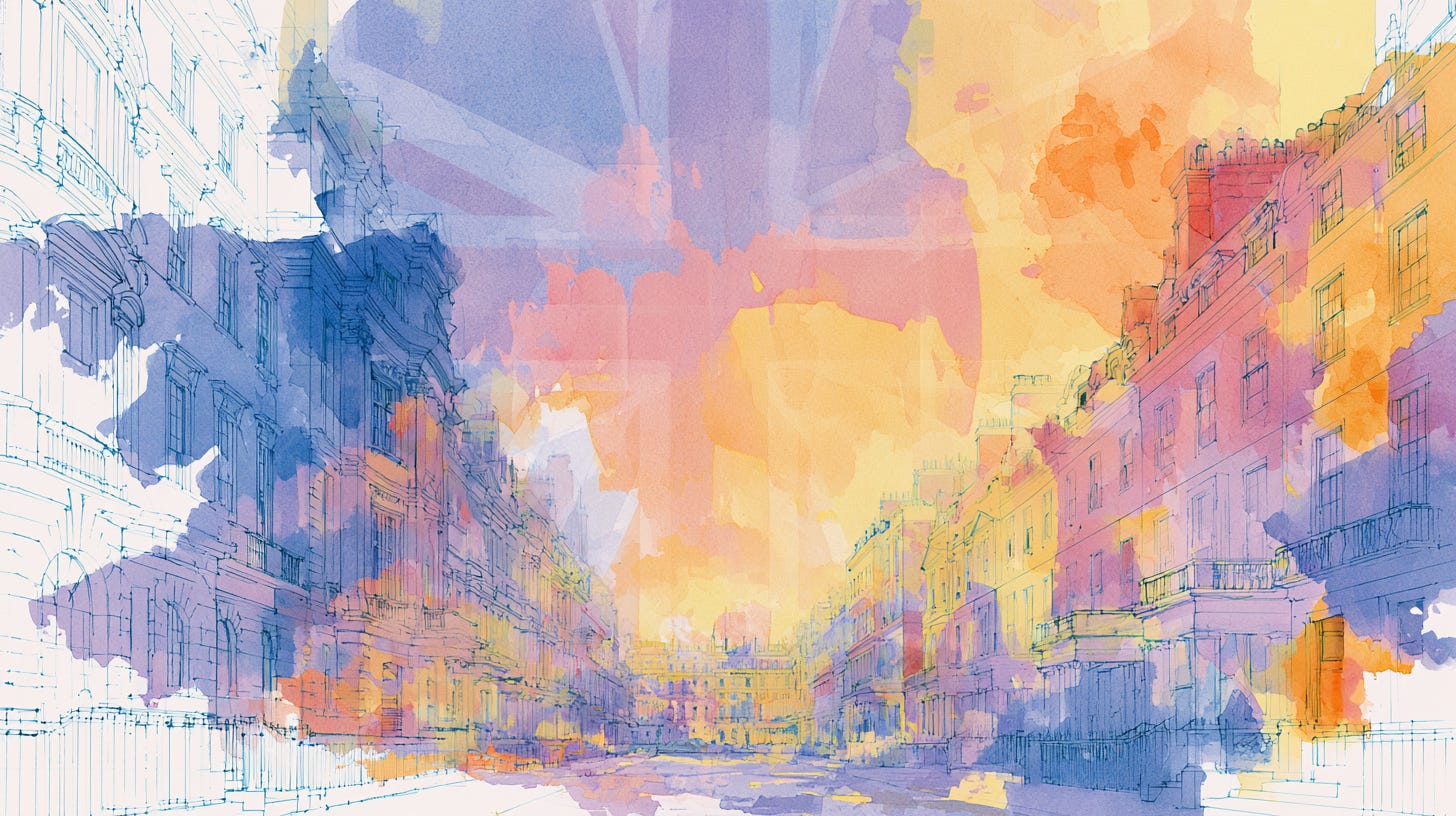
We convened for gin-and-tonics before the event, then piled into a black cab that whisked us across town to Saint James’ Square. In that gorgeous spring, the plane trees and pin oaks were in full leaf, and we were half-cut. The East India Club commanded the square, torches blazing along the pavement as if to keep alive the waning flame of Empire. We were ushered upstairs to the Ladies’ Drawing Room, where we were packed in likely violation of some fire code—but women were allowed there. A stage and podium were arranged at the front of the room, behind which large windows were thrown open onto the May day beyond. A bar was tucked against the side wall, and more G&Ts procured. The large doors at the back of the room were closed at the appointed hour, and soon screens flanking the dais began playing a photo montage celebrating Mrs. Thatcher’s reign. Elgar’s “Land of Hope and Glory” provided the soundtrack, while the assembled masses sang along in a pomp-ish version of karaoke:
Land of Hope and Glory, Mother of the Free,
How shall we extol thee, who are born of thee?
As the chorus ended and the orchestral track sounded its final, triumphal notes, there was a pause and a hushed silence—and then the giant doors burst open, and all of us looked out, and then down. And there she was: or, at least, there was the top of her iconic bouffant hair helmet. The Iron Lady was short, but age and retirement had not reduced her power: the crowd split of its own accord, creating a path to the dais. Liam Fox, then Chairman of the Conservative Party, was playing bodyguard. I pushed my way through the throngs, pronouncing “sorry” with a British accent and an elbow-shaped circumflex, and thrust my hand into the Baroness’s path. Her eyes locked briefly with mine as she grasped my hand.
I retreated to my gay companions, left with the lingering memory of her lavender touch.
For we were not the only homosexuals in the room. Gays gravitated toward the Tories, and to Thatcher in particular, in part for political reasons and in part for social and aesthetic ones. Thatcherism was not merely a set of policies but a milieu of clubs, country houses, dinner parties, the palaces of church and state, ancient institutions, and timeless wit. Indeed, many of the men in her orbit—gay or straight—seemed more attached to that world than to Thatcherism itself. Meanwhile, the socialist-inflected Labour Party was not a natural home for Oxbridge-educated homosexuals who were too well-bred-and-read to take up the red rose. If the Tory world offered status, glamour, tradition, and access, Labour offered coal mines and picket lines. Indeed, many Marxists saw homosexuality as a decadent, bourgeois lifestyle, a symptom of the sickness of capitalism. Conversely, all gays knew that Marxism definitionally had no taste: in rejecting elites, it inherently rejected the tastemakers.
Thatcher was neither a champion of gay rights nor a straightforward enemy. She had supported overturning laws criminalizing homosexual acts, “which she considered a humiliating intrusion into privacy and a waste of court time,” according to biographer Charles Moore. She employed “a good many homosexuals,” promoted them, enjoyed their camp behavior, and seemed largely oblivious to their sexuality, often trying to set up “suitable” husbands for her secretaries without realizing the men in question were gay. While Thatcher personally disapproved of homosexuality on religious grounds, she also tolerated the “sexual peccadilloes” of her gay subordinates so long as they kept them out of the press.
Her instinctive tolerance existed alongside profound blind spots. She presided over a gay panic that stemmed in part from her government’s fraught handling of the AIDS crisis. Her government also passed the notorious Section 28 law banning the “promotion of homosexuality” by any local authority in 1988. Although 83% of the British public supported the ban when it was passed, Section 28 had the unintended consequence of galvanizing the British gay rights movement and bringing actor Ian McKellen out of the closet.
Mother of the Free, indeed.
In the Ladies’ Drawing Room, with the windows thrown open as if to invite an assassin, the Iron Lady took to the stage to thunderous applause. Although Mrs. Thatcher had largely withdrawn from public life following the death of her husband Denis the year before, she gave a short speech. In it, she warned that the Conservative Party was losing touch with ordinary voters, years before the Global Financial Crisis and Brexit would reorder British politics—and a full decade before a Conservative government would legalize same-sex marriage over the objections of most of its own MPs. “We’ve got to get back in touch with the people,” she said.
“We’ve got to get back to the bar,” said my friend, whose boss was one of those MPs, along with Liam Fox, who’d vote against gay marriage.
After the speech, the Baroness descended from the dais and zigzagged her way through the crowd, Fox keeping a wary eye—Thatcher at his elbow, Thatcherism at arm’s length. As she wended closer to our group, I grabbed my friend and pushed forward again, calling out, “Lady Thatcher, could I get a photo?”
“Of course!” she declared.
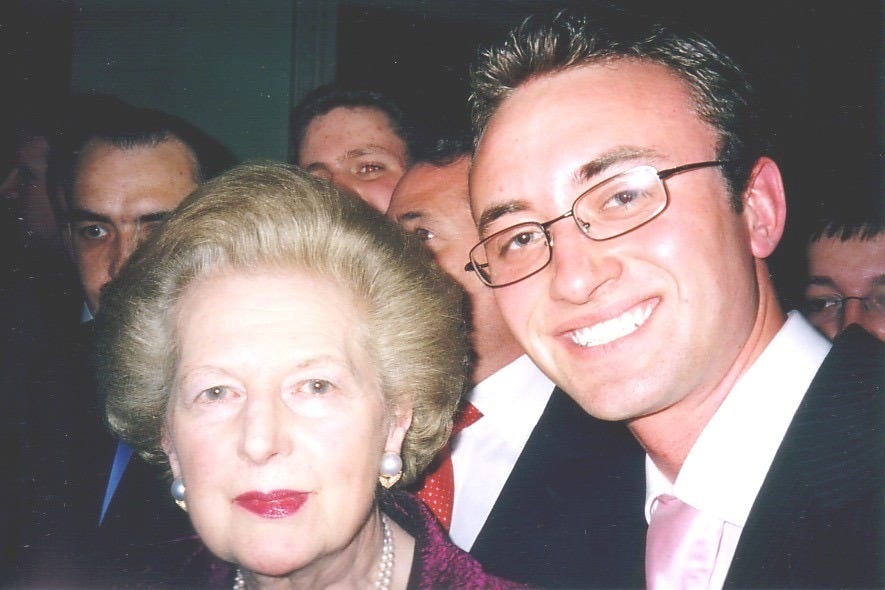
My friend took my camera, and I, being American and having no idea what to do with a British lady—iron or otherwise—threw my arm around the buttery satin of her waist. Meanwhile, my friend couldn’t figure out how to get the bloody thing to work, and so we stood there in silence. If a pause could seethe, I heard it in the restless crowd around us. The photo captures the faintest ghost of a smile on Mrs. Thatcher’s ruby-red lips, and the placidity of a face that had long grown accustomed to useless men. I, of course, am beaming, while a glimpse of Liam Fox appears between our heads.
French President François Mitterrand once said of her, “She has the eyes of Caligula and the lips of Marilyn Monroe.” Lady Thatcher’s skirts didn’t quite twirl up around her, but no sooner had an embarrassed “Thanks!” escaped my lips before she pirouetted from my American embrace with a throaty “Aaaaawlright”—and returned to the people.
As we left the gentlemen’s club, we slid past Savile Row suits and Jermyn Street shoes to return to our place among the rabble. The torches outside the club blazed bright beneath a dusky sky as we piled into another cab en route to Soho Square. At a gay bar called Sanctuary, we joined a larger gathering of Conservative Party gays who didn’t make it to the East India Club. The men in Soho were no less polished than the men in Saint James’. Their accents were just as posh, their tailoring nearly as sharp, and many had passed through the same Oxbridge colleges and parliamentary offices. The atmosphere was decidedly more camp but no more theatrical than the other gentlemen’s club from which we’d just arrived. Bartenders mixed us G&Ts, and I mixed and mingled with the Tory disestablishment, coming out only as an American, even as I peeked through the lavender door.
From the East India Club to the gay bar, we had gone through the looking glass. Behind closed doors, the homosocial and the homosexual were less discrete—and the latter less discreet. In both spaces, men gathered among men to enjoy the kind of intimacy and companionship that existed apart from ordinary domestic life. The East India Club excluded women as a rule; the gay bar invited them in on certain conditions—but in either, it wouldn’t have been too difficult to imagine the Iron Lady sitting in a Chesterfield sipping an ice-cold G&T. Meanwhile, the gay men moving between those spaces were doing what they’d always done: finding the rooms, official or otherwise, where they could be some version of themselves. Moving between those spaces myself, I’d spent the entire evening in the company of men, as it were—quite how Mrs. T herself preferred it.
And I wondered: in those halls of power where princes, dukes, and even Denis Thatcher had found a sanctuary among other men—had it ever revealed itself under that roof, the love that dare not speak its name?
If you enjoyed this, consider upgrading to a paid subscription—where you’ll be in good company and have access to all paywalled essays.
I love this…I’ve seen this photo for years but how awesome to paint the picture and feel a fraction of the energy you were feeling at that moment. One of my favorites yet :)
Nice essay, she was a true force, an Icon of Power. I loved reading this vignette; I could feel the emotional kinetics as everyone swayed in time (fun are these moments, fueled by vigor and allure).
Not everything went right with her governance, but I believe her heart was in it. The "Right to Buy," if privatized, may have worked for her. What a moment!