


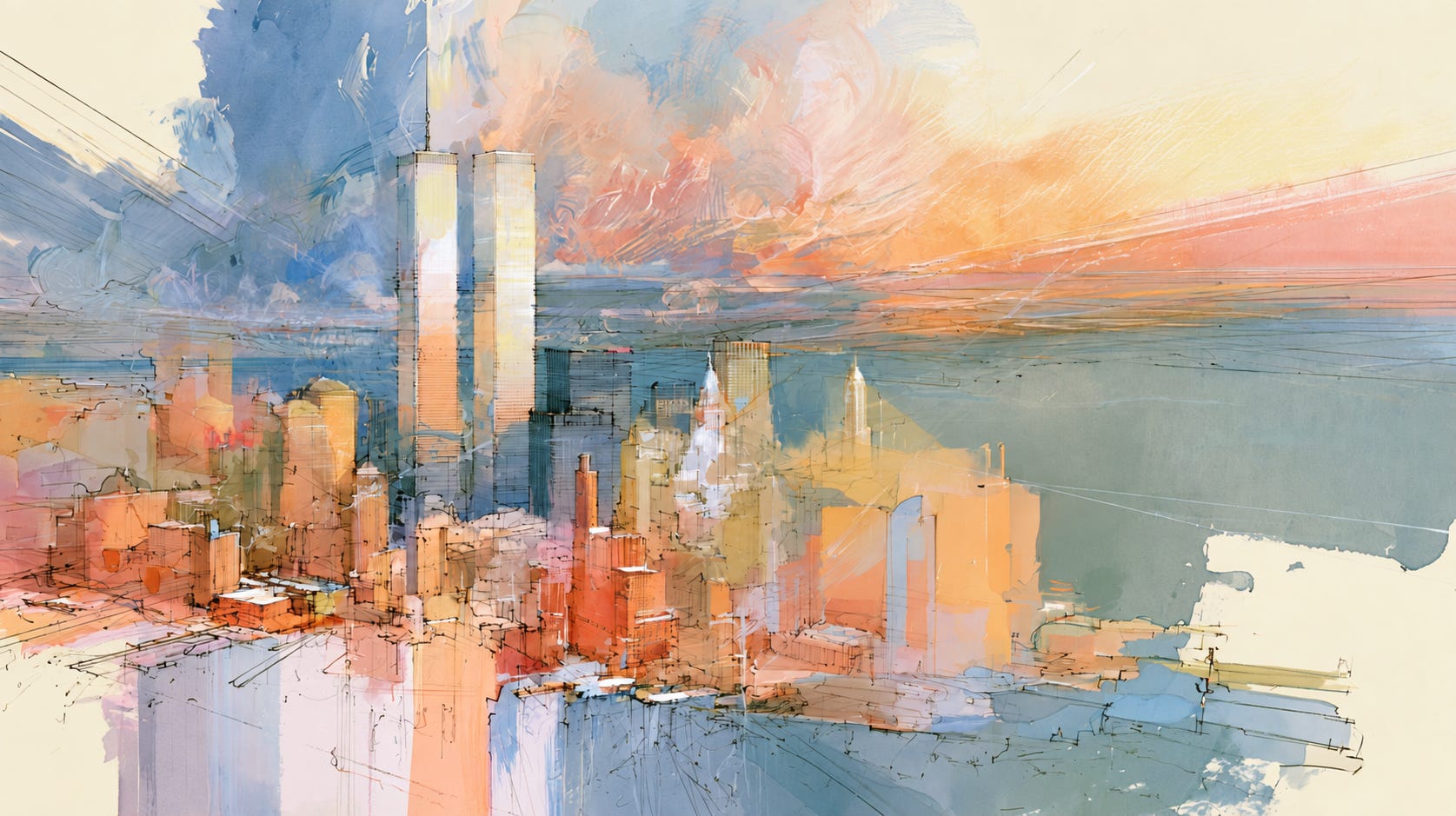
I first saw the Twin Towers with my own eyes on a family road trip in the early 1990s, while we were driving to Disney World from Southern Connecticut. My parents had woken us up hours before dawn and stuffed us into the rear of a Hyundai hatchback: my sister in her car seat between us, my brother and me wedged against opposite doors, sleeping on pillows. Sometime along our drive down the New Jersey Turnpike, I opened my eyes to the New York skyline, its buildings silhouetted against the fading dark as the first rays of dawn gathered behind them. The World Trade Center dominated Lower Manhattan, two geometric monoliths towering over the more elegantly tapered profiles of the prewar city, as though the bedrock had thrust them fully formed into the sky. Seeing them in that half-light, it was impossible to comprehend their scale: they were too large, or the surrounding city too small—or somehow both.
How could those buildings, seemingly connected to the core of the earth itself, ever be gone?
I never set foot in the World Trade Center complex, but its presence in New York was an immutable fact of my early visits to the city. The towers loomed in photos taken from Liberty Island or the top of the Empire State Building, appeared as glimpses between uptown avenues, or suddenly filled the windows of a coach bus as we passed along West Street, close enough to see the enormous tridents framing the North Tower lobby. In September 2001, I had just started college at Boston University when two planes flew out of nearby Logan Airport one bright Tuesday morning. As the world ruptured that morning, I had the profound feeling that my childhood had finally ended.
Still, childlike disbelief brought me to visit, in January 2002, what we mercifully no longer call Ground Zero. I remember steam or smoke wisping from a mountain of rubble: steel bent into shapes no longer resembling beams, the broken shards of the iconic ribbed cladding, the detritus of offices and God knows what else. The fires were officially put out earlier that December, but the occasional hot spot was uncovered as debris was removed. I don’t know if the wisps I recall were real or recreations, but the rubble was certainly there.
When I graduated from college in 2005, I moved to New York. By then, Ground Zero had taken on a new meaning: it was a giant hole in the ground where zero seemed to be happening. The site had been cleared and construction preparations had begun in 2004, but the officials—governors, the mayor, developers, financiers, insurers—continued to fight about everything. Our moment of national unity had already fractured over the Iraq War, but war had broken out on the World Trade Center site almost immediately. Who would pay? Who owed what? Whose vision should prevail?
Progress happened in fits and starts—or by grown men throwing fits. The buildings around the periphery had their blown-out windows replaced and structural damage repaired, while 7 World Trade Center rose steadily on a privately-owned adjacent site. The defining feature of Downtown had become the Bathtub, a vast excavation on the western side of the sixteen-acre site with a seventy-foot-deep slurry wall studded with steel tiebacks to hold back the Hudson River. Looming over that maw, the abandoned Deutsche Bank building stood for years with a twenty-four-story gash in its side. Even its demolition proved fatal: a seven-alarm fire killed two more firefighters and injured 115 others.
In the early years, I would regularly hear stories from New Yorkers who had seen the second plane hit, who had trudged on foot across the Brooklyn Bridge as Lower Manhattan was evacuated, who had colleagues or contacts who simply vanished that morning. Eventually, those stories stopped getting told. Each year, the Tribute in Light would pierce the night sky on the anniversary, casting its ghostly columns into the void, and we’d sometimes walk the long blocks from our apartment on West 44th Street to Pier 84, stretching 1,000 feet into the Hudson, to catch the view. Inevitably, though, the anniversary became another date in the calendar—meetings, appointments, travel still had to be scheduled. We’d see the light in the sky and then remember the date.
For years, I would take out-of-town visitors down to the former site of the towers, and we would peer through the official Ground Zero Viewing Wall for signs of progress. Gradually, the hole began to take shape: the foundation of what was first called the Freedom Tower, later rechristened One World Trade Center, and the footprints of the Twin Towers that would be forever memorialized as Reflecting Absence, its waterfalls cascading into another void.
It was the emergent shape of the tower and memorial that brought context and meaning back to the site. When the memorial opened in 2011, one could stand at the former base of each tower and look up, and then imagine the bolt from the blue that created the endless upward emptiness. One could look down and trace the names of nearly 3,000 people as waterfalls drowned out the street noise and cascaded into another infinite void. One could look down again, more closely, and trace, ten times, the phrase “and her unborn child” and understand that what we saw in the TV footage was not only buildings falling but the lives they carried with them. One could look down farther still, into the Bathtub, where a museum opened a few years later with artifacts, exhibits, and a gift shop—but I still haven’t been able to bring myself to descend into it.
Memory warps and wobbles as it attempts to contain the unfathomable.
Controversial when proposed, unloved when constructed, the towers were sanctified by the violence of their destruction, displacing earlier memories. What many remember of the original World Trade Center was its windswept plaza, its humiliating scale, the way it obliterated the streetscape and lifted itself like a citadel above the neighborhood. Among much else, we hardly remember what it replaced: the bustling Radio Row, Washington Market, the Hudson Terminal Building, and other landmarks of the “thirteen historic, living and breathing square blocks of the city” that were destroyed in what Harper’s Magazine called an act of “urbicide.”
The original World Trade Center employed the methods and epitomized the spirit of the urban renewal era at enormous scale. The project was dreamed up by the technocratic Rockefeller brothers—Nelson, as governor, and David, as CEO of Chase Manhattan Bank—and the bureaucrats of the Port Authority of New York and New Jersey. Using the power of eminent domain, the Port Authority seized sixteen acres of Lower Manhattan, displacing some 300 businesses, 30,000 employees, and 100 residents, ultimately demolishing 164 buildings and closing five streets. Meant to revitalize an ailing Downtown, the complex instead flooded the market with 10 million square feet of new office space, creating a supply glut that depressed real estate values and only worsened the economic slump. For years the Port Authority struggled to lease the complex, offering below-market rents to lure tenants from other Downtown buildings, while cross-subsidizing losses with revenue from its bridges, tunnels, and airports. Meanwhile, the tax-exempt authority took sixteen acres off the city’s property tax rolls. Still, by 2001, the towers were nearly full, instantly recognizable around the world, and inextricably tied to the identity of New York.
Folly, failure, icon, target: in the span of 102 minutes, it all came down.
We’ve been writing and rewriting our memories of what actually happened since almost the moment the first plane struck the North Tower at 8:46 a.m. The terrorists had cast the Twin Towers as pillars of American capitalism, symbols of its power and decadence. Their tenants included investment banks like Cantor Fitzgerald and insurance brokers like Aon Corporation—but also New York State and the Port Authority itself. In actuality, the towers embodied the American mixed economy and the often hazy relationship between bank and state. As targets, the towers were useful because of what they were perceived to stand for, not the entanglement of government power and private ambition that had made them stand.
Grief and anger demanded a defiant response, prompting calls to rebuild them safer and stronger. The approach taken instead was beset by petty politics, giant egos, appalling myopia, and absurd visions. Calatrava’s transit hub, meant to open its wings like a bird, became a financial albatross value-engineered into a skylight designed to crack open each anniversary—but hasn’t in years due to ongoing leaks. Despite it all, the still unfinished result is something better than what was there. The new complex reconnects the site to the surrounding grid, replacing a plaza hostile to pedestrians with streets they might actually want to walk and a lush canopy of trees where the original towers offered only a paved and shadeless plain. It also has some echoes of the old: where electronics vendors once peddled radio parts, Spotify now has its US headquarters.
In the center of it all is the memorial, inviting us to reflect on the absence of what was so horrifically destroyed twenty-five years ago. The Twin Towers stood on that site for nearly three decades, while the memorial punctures it, permanently, with what happened on their final day. Already, some 100 million Americans have no memory of what happened on September 11th. One day, when the last of us who remember have ourselves faded into memory, when the swamp white oak trees soar over the memorial plaza, when the bronze parapet bearing all those names has weathered green, when the city has absorbed it all into its daily fabric as another immutable fact—perhaps then the absence of those towers will truly be reflected. No one alive will remember seeing them there.
My memory of the towers is more personal. There were two restaurants on the top of One World Trade Center: A large one called Windows on the World, and a 40-seat, upscale, prix fixe restaurant called Cellar in the Sky. Cellar was the special place for my husband and I, for Valentine's Day and other special dates. So, when we got married, our wedding reception was at Cellar. Indeed, we tailored our wedding to be small enough to fit into it. Not only that, but our wedding dinner wound up setting their prix fixe menu for the restaurant for the next two weeks (minus the wedding cake)! I will always miss them.
This is a beautiful reflection of so much complicated history. I grew up not far from there. My childhood sketches of "city" always included tall, twin towers to mark one end. I sketched the towers again in my architectural thesis, as a grounding icon seen all the way from the west side of Union Square. I'd moved away by 911 and didn't make it back until three years ago, surprised to learn how easily I was still brought to tears, crying the instant I rounded the corner and saw the new plaza, memorials and building. You've included so many details I've thought about over the years, architecturally, culturally, historically and emotionally. Always love your posts, and especially thank you for this one.