


City of Yes is a reader-supported publication. If you find this work valuable, please consider becoming a paid subscriber. Thank you for your support!
On Election Day in 2025, Austin’s reliably blue voters overwhelmingly defeated Proposition Q, a property tax increase the City Council had put on the ballot to close a budget shortfall and avoid cutting essential services. The tax rate election failed in a year when affordability was a winning issue across the country, and amid local frustration over a million-dollar logo boondoggle and persistent visible homelessness. The city responded by paring back roughly $100 million in planned spending. This year, some of those same groups who opposed Proposition Q are backing Proposition I, a charter amendment requiring external audits of city departments at least every five years and before any future tax-rate election.1 At the same time, voters are also being asked to approve $295 million in parks and library bonds, alongside a modest tax increase. How voters will decide on November 3rd remains to be seen: they want parks and libraries—and police and firefighters and homeless prevention services—but they want lower tax bills, as well.
How does a city pay for what its voters want without raising their taxes? The state has left Austin with few ways to try, but rethinking how cities tax property might offer one.
Running local government isn’t cheap, and because it’s subject to the same pressures as households, it isn’t getting any cheaper. To pay for it all, Austin is limited by Texas state law, which allows municipalities to collect only 3.5% more in operating property-tax revenue each year from property already on the tax rolls; anything more must be approved by voters in a tax rate election like last year’s Prop Q. This is obviously challenging for city governments in a high inflationary environment, no matter how solid their underlying fundamentals or how efficiently they provide services. Today, short of another tax rate election, new development is essentially the only way to grow property tax revenue beyond the 3.5% cap, but even that source is shrinking: new construction is expected to add about half as much value this year as it did two years ago.
Austin’s $1.54 billion General Fund covers services like public safety, parks, and libraries. Property taxes, at $743.9 million, pay for less than half of those services, with the rest paid for by sales taxes, utility transfers, user fees, and other sources. The city collects another $538.7 million in property taxes committed to voter-approved bond debt, the Project Connect bus expansion and light rail construction, and some dedicated tax reinvestment zones. Nearly two-thirds of the General Fund—more than $1 billion—goes to public safety, split between Police, Fire, Emergency Medical Services, and Forensic Science. Parks and libraries account for another 14.3% of expenditures, with the rest divided across many departments with smaller budgets.
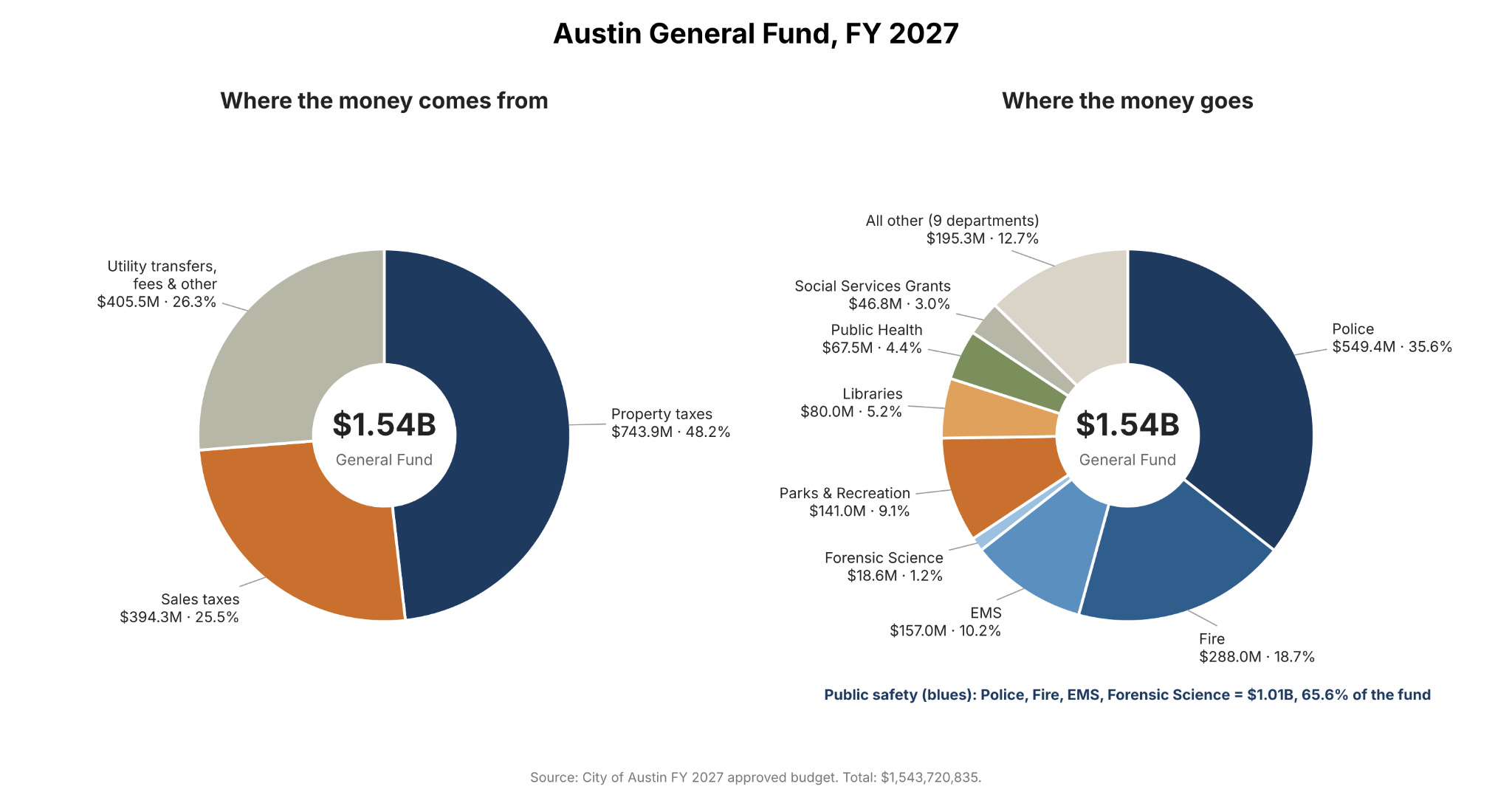
Those supporting Prop I are hoping that an external auditor will uncover major savings that can flow to property tax cuts. But state law penalizes cuts to police spending, the General Fund’s largest expenditure. And even if Austin eliminated every General Fund expenditure outside public safety—parks, libraries, public health, and everything else—it would still need to raise more than $210 million in property taxes, assuming other revenues remained unchanged. That would leave untouched the separate property taxes committed to bonds, Project Connect, and other designated purposes. The audit would also cover the city’s utilities, but savings there would show up mainly in utility rates, not property tax bills.
The city could certainly spend better: it spends money on things it probably shouldn’t (the new logo comes to mind) and the city’s own audits should attempt to identify meaningful savings. But substantial tax relief would require substantial recurring savings—and any savings would leave the underlying question of how to fund the services voters want as their costs rise.
One structural change that is aimed at both the homeowner-relief demand and the long-term revenue problem is to stop taxing buildings as if they were the problem. Indeed, Austin could collect the same revenue while lowering bills for many homeowners if it shifted more of the burden onto valuable, underused land.
Austin is a valuable place, and Downtown Austin has some of the most valuable land of all. The below graphic, from the Center for Land Economics’s Civic Mapper, shows a visual representation of the land value of the city. The tall yellow bars represent the most expensive parcels, while the purple parcels are the cheapest. Essentially, this is a visualization of the value of density—or at least potential density.
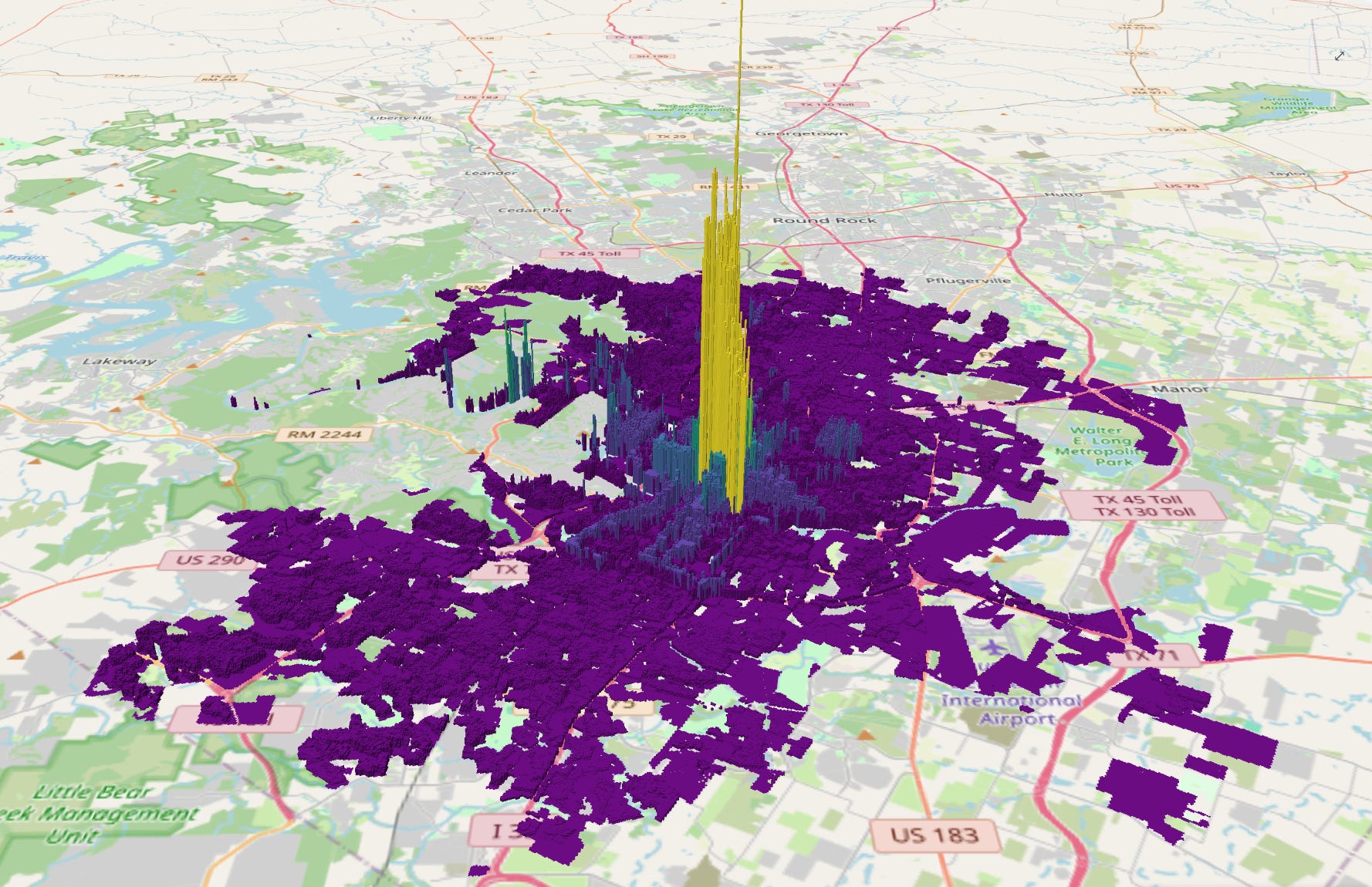
Despite the high value of land throughout Downtown and the surrounding neighborhoods, it’s not uncommon to find vacant lots, parking garages, and parking lots sitting next to million-dollar homes, Michelin-starred restaurants, and some of the city’s most iconic sites. According to the Parking Reform Network, about 15% of Downtown Austin’s surface area is parking lots or garages. Across the city, the Center for Land Economics estimates that there are some 3,650 acres of land worth $4.4 billion devoted to parking—a number that excludes vacant and underdeveloped lots.
Many of these lots have been vacant or underdeveloped for decades despite market pressures. One reason why may be property taxation: when holding land costs so little in taxes, an owner can afford to wait indefinitely.
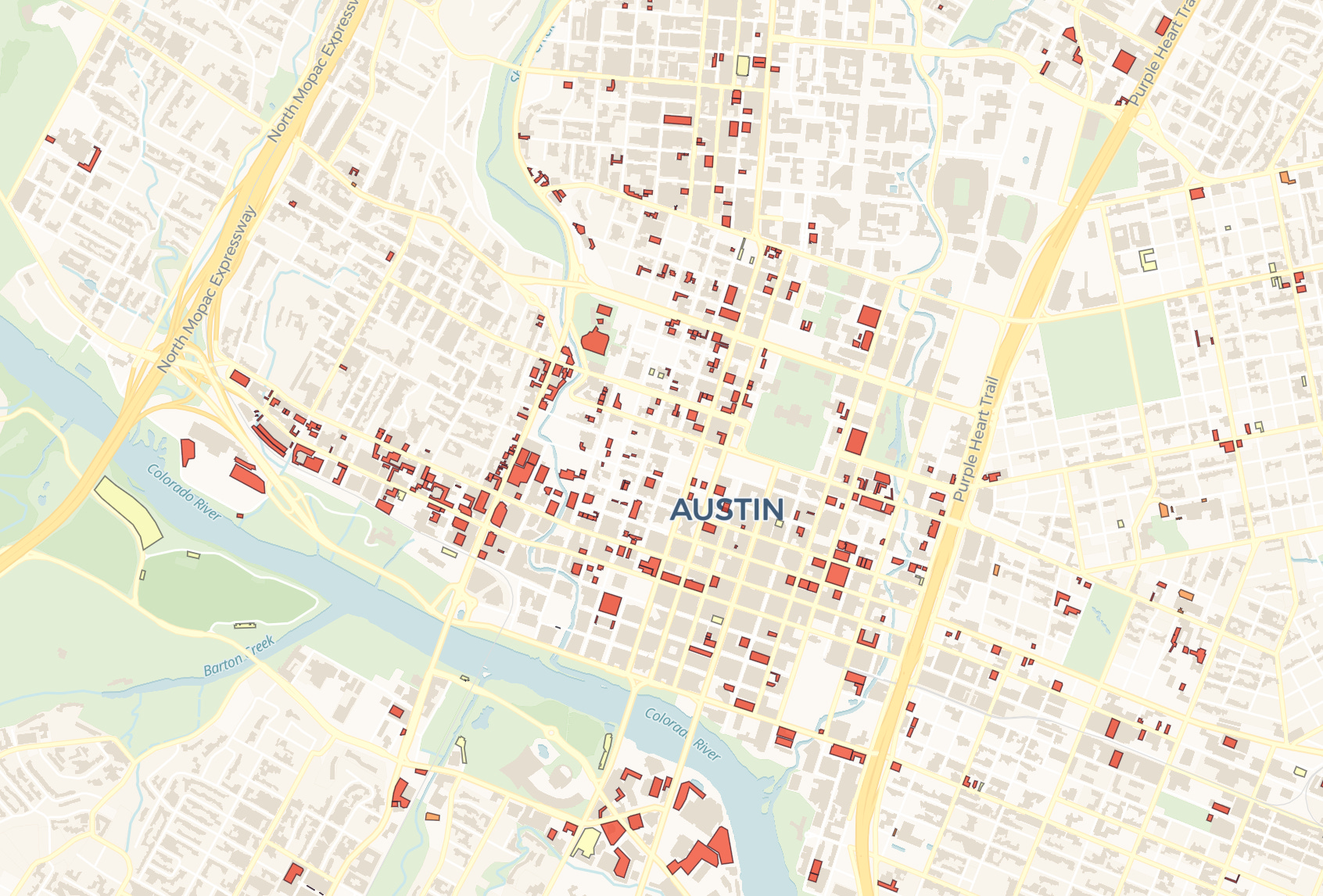
One block in the Downtown Rainey Street district shows the practical consequences. At more than one thousand feet tall, the Waterline tower has reshaped Austin’s skyline, turning a formerly vacant lot into homes, hotel rooms, offices, and public amenities. Across the street sits a parking lot. The two sites have similar appraised land values per acre, but the Waterline will pay the city about $1.08 million per acre in taxes versus only $175,000 for the parking lot. The difference is the skyscraper itself: the city taxes improvements as well as land. Leaving the neighboring site as parking avoids most of that additional tax burden.2
A land value tax would address this disparity by shifting the tax burden from buildings to land, with a higher rate on land and no tax on improvements. A split-rate tax, a common alternative, moves partway there, taxing land at a higher rate than buildings.
In our example, the Waterline and the parking lot have nearly equal land values per acre. Under a pure land value tax, the two sites would pay about the same tax—roughly $650,000 and $610,000 per acre, instead of the current $1.08 million and $175,000—while the city collected the same total tax from the pair. A split-rate tax would tax the building at a lower rate than the land, narrowing the difference between their bills. Either system could be designed to be revenue neutral, but a land value tax would change who pays and what gets built. Vacancy or underdevelopment would no longer avoid taxation, while building would incur limited or no tax penalty. Because the land tax is spread over more units as owners build, the incentive is to build as much as zoning allows, so that Downtown parking lots become skyscrapers and vacant lots become homes.3
The Center for Land Economics has modeled what the implementation of a land value tax would look like for different cities. In Cincinnati, for instance, they found that the median single-family homeowner would pay less in property taxes, but about one in four would pay more. In Spokane, the median single-family house would see a 4% decrease in taxes, while taxes on the median small multifamily building would decrease by 10%. A study of a split-rate tax in Syracuse found that residential property taxes would decrease in almost every residential neighborhood while raising taxes on parking lots and vacant land.
Evidence from places that have implemented land-focused taxation also suggests benefits beyond redistributing tax bills. The Center for Land Economics cites evidence from Pennsylvania, where cities that shifted taxes toward land were associated with an increase in housing production and infill development, including an estimated 13% increase in housing units under construction in Pittsburgh. Another study found a 12% increase in business establishments after cities moved toward land-focused taxation, especially in space-intensive industries like retail and manufacturing.
Austin’s own results would depend on local modeling, but the pattern in these cities is consistent: tax bills fall on many homes and apartment buildings and rise on vacant and underused land. In Austin, that likely means owners of expensive, underbuilt central land would have the most to lose and the most reason to oppose the change.
The city wants two things: to ease the pressure of rising property taxes on homeowners, and to pay for services without cuts. A revenue-neutral shift to a land value tax speaks to the first by lowering bills for many homeowners. Whether it could pay for services without cuts is a bet. Today, new construction adds taxable value to the tax rolls; under a land value tax, a new building would add little or nothing, and under a split-rate tax it would add less than it does now. So the city would be giving up that growth and wagering that more building, more economic activity, and more revenue from sources such as sales taxes would make up for it.4
Today, Austin has a tax system that is anti-property, one that penalizes building and encourages parking lots. Implementing a land value tax would take an act of the legislature and a constitutional amendment—an uphill battle, for sure, but one worth pursuing as Austin voters continue to fight City Hall. In the meantime, Austin could evaluate which fight is worth fighting by modeling how a pure land value tax or split tax would impact property across the city. A land value tax would not fix every problem with municipal finance, nor satisfy those who want to eliminate property taxes altogether. But it could offer many homeowners lower bills without cutting the services they want, while encouraging more economic activity overall. That might be the best long-term answer to the anti-property-tax revolt.
City of Yes is does not have the authority to levy property taxes. If you find this work valuable, please consider becoming a paid subscriber. Thank you for your support!
City Council has already adopted its own audit by ordinance, so the main difference is that a charter requirement can’t be changed by council, only by another election. Opponents see this as a redundant if not ironic waste of taxpayer resources.
All figures are derived from the author’s analysis of Travis Central Appraisal District data. For purposes of simplification, I’m only referencing the city’s portion of property taxes here. Austin property owners are subject to taxation levied by several property tax districts, including the Austin Independent School District, one of three county governments, and Austin Community College.
Zoning reform is a natural complement to land value taxation. Read City of Yes for more!
The reduction in public grievance is potentially priceless.
Kudos for another great insight! Amazingly it's even started directionally downtown in a consequential manner. CBD is a yawn, it was mapped in the streetcar era, but this mindset can help better align the built environment with Austin’s 21st century mobility model & central city goals. We have some downtown SF3 zoned lots (lol) TCAD reappraised at $200 per square foot in 2026 just for land <=> only one of those can be right <=> both SF3 & $200/SF for land tax can only co-exist on Bllionaires Row, and NYC ain't conceding that to us.
I like the idea of the split tax rate; I think it provides both greater and more stable revenue.