


The full version of this essay is available to paid subscribers of City of Yes. If you find this work enjoyable and valuable, please consider supporting it with a paid subscription. Thanks for reading!
It looks like a normal neighborhood. Its modest raised ranches sit on large grassy lots enclosed by fences. Leafy trees and tidy sidewalks line the street, cars are parked in the driveways, pools and patios appear in backyards, waiting for the warmth of summer. It could be anywhere in suburban America—but a few clues suggest it is not. An elevated subway train rolls by just a couple blocks away. Neighboring row homes and six-story apartment buildings come right up to the property lines. There are paved-over vacant lots right across the street, a legacy of the neighborhood’s near-death and partial recovery.
This is the South Bronx—and this suburban subdivision, Charlotte Gardens, sits amidst one of the densest neighborhoods in America. That it exists at all tells you something about what the urban renewal era ultimately produced.
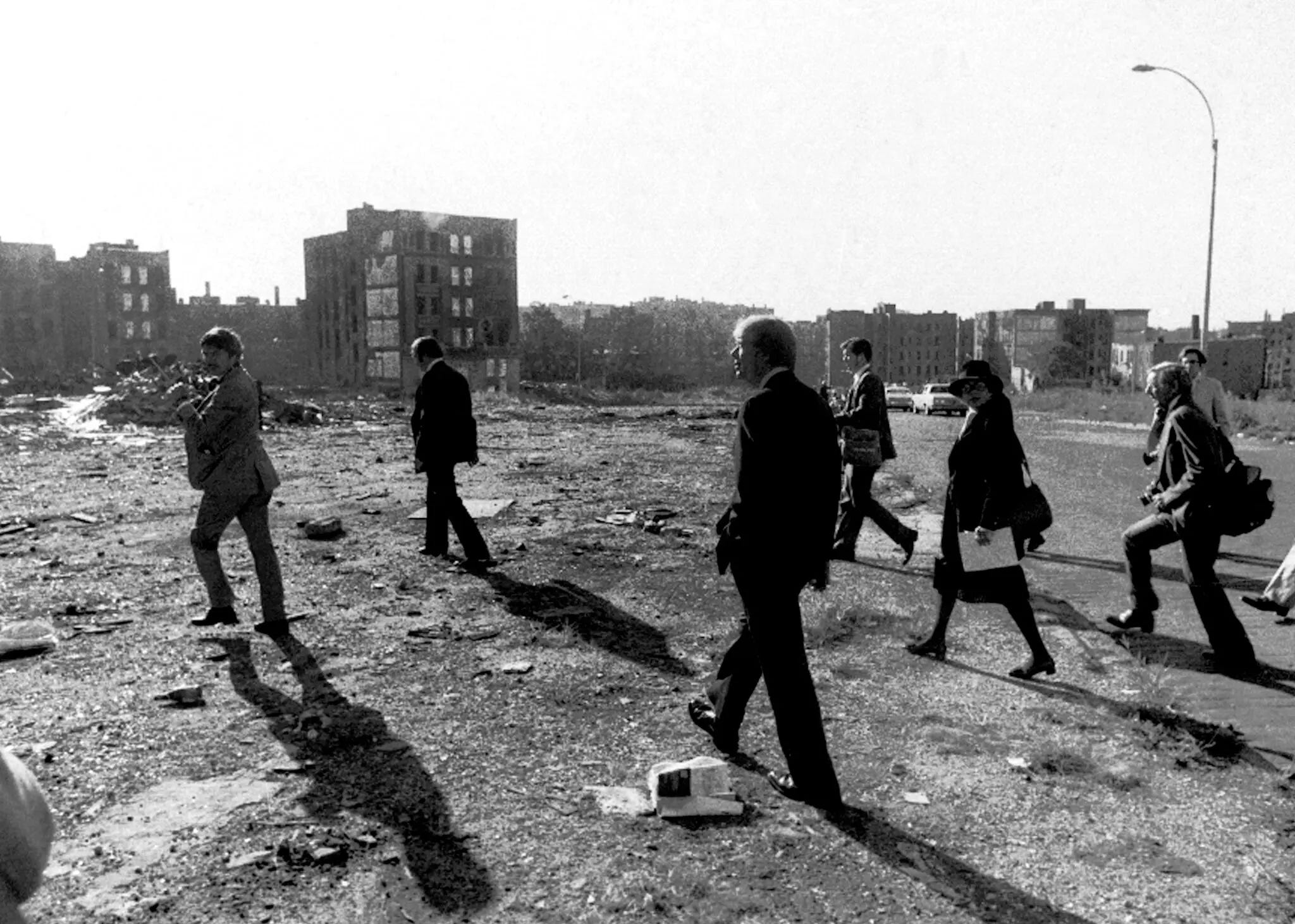
When President Jimmy Carter visited Charlotte Street in 1977, there were no gardens—only rubble and the husks of firebombed buildings. He was standing on the ruins of a generation of urban policy failure. What had been thriving communities of Irish, Italian, and Jewish immigrants for a generation began to decline after World War II. The redlining of “ethnic” neighborhoods began a process of disinvestment in quality housing stock, while federal mortgage policy drew the middle class out to the suburbs. Robert Moses’s construction of the Cross Bronx Expressway fatally sliced through the borough, displacing 60,000 people and blighting the adjacent land. Later low-income housing projects further concentrated poverty in the Bronx, while factories closed and good working-class jobs moved away. Crime rose, schools failed, and people left in droves. What they left behind became the poorest zip code in America.
Against this backdrop, declining land values coupled with rent control created perverse incentives for property owners. Rents didn’t cover costs, arson was cheap, and a match was worth more than a mortgage. By the 1970s, there were 30 arson fires a day—12,000 per year—making local Engine Company No. 82 of New York’s Finest the busiest firefighters in the country. A hapless City Hall was considering a policy of “planned shrinkage,” essentially giving up on the borough.
And so the Bronx burned.1
It was into this “urban wilderness” that Ed Logue stepped in 1979. Logue had made a name for himself in New Haven, Conn., where his attempt to build “The Slumless City” displaced more than 30,000 people. In Boston, he remade its historic downtown into the monolithic Government Center, displacing thousands more. Under the logic of urban renewal, these were considered successes. That record brought him to New York, where Governor Rockefeller put him in charge of the Urban Development Corporation. The UDC built projects all over the state, including the subsidized housing projects in the Bronx that had accelerated its decline, but its dependence on federal dollars and its sloppy finances left it exposed when Washington pulled back funding. In 1975, the agency defaulted on its debt, leaving dozens of projects unfinished, and Logue resigned in disgrace.
“Mr. Urban Renewal”—the man who had razed and rebuilt entire cities—would end his career building a suburban subdivision.
