



We’re celebrating 250 years of American urbanism at City of Yes this month. If you find this work valuable, please consider supporting it with a paid subscription. Thanks for reading!
Pierre Charles L’Enfant is remembered today for his design of Washington, D.C., but by the time he died in 1825, he was nearly penniless and all but forgotten. When a new generation rediscovered him in the early 1900s, his body was exhumed from its original, lonely burial site. Only a couple bone fragments and a tooth remained of the man whose hands had drawn the lines from which a city emerged amid a rolling wilderness. L’Enfant was given full honors and reinterred atop the hill at Arlington Cemetery, to spend eternity looking out across the Potomac over the city that bears his imprint. While L’Enfant would recognize the bones of his plan in the capital he designed, he might not recognize much of its spirit—for Washington, D.C.’s development did not go at all according to plan. Although L’Enfant was a brilliant artist and visionary planner, he could not see his own deficiencies in that one art that would come to define the District of Columbia more than any other: the art of the possible.1
L’Enfant would learn the hard way that all urban planning is political.
L’Enfant’s improbable life story began in 1754 in Paris, where he grew up the son of a court painter to Louis XV, before training at the Royal Academy. There, he absorbed the lessons of great French urban landscapes, especially the grand avenue of the “seemingly infinite” Champs-Élysées. He left France to join the American cause in 1777, and as a soldier in the Continental Army distinguished himself as an illustrator, earning the attention of Baron von Steuben, Alexander Hamilton, and George Washington. After the war, Hamilton commissioned L’Enfant to design New York’s Federal Hall, launching his career as a planner and precipitating his greatest commission: the design of the nation’s capital.
Under the new Constitution, Congress passed the Residence Act of 1790 to create a “district of territory not exceeding ten miles square, to be located as hereafter directed on the river Potomac.” Congress authorized the president to appoint three commissioners to buy, survey, and build a capital ready to receive the government by December 1800, when it would relocate from its temporary home in Philadelphia. Washington selected commissioners with deep ties to the tidewater area and to himself: all three were investors in the Potomac Navigation Company, alongside the president. The job of surveyor went to Andrew Ellicott, already famous for finishing the Mason-Dixon Line. L’Enfant appealed successfully to the president for the opportunity to become the new district’s Planner in Chief.
Thomas Jefferson believed the plan for the city should reflect republican modesty, proposing a simple grid of some fifteen hundred acres with a public walk connecting the President’s House and the Capitol. While Jefferson believed that cities were moral morasses, the territory that L’Enfant encountered was not the swamp of lore but “a quiet, sparsely inhabited territory of hills, forests, farms, and wetlands.” Within this 100-square-mile diamond, L’Enfant envisioned a capital that would dispense with the rectilinear grids of cities like Philadelphia, which struck him as “too simple and uninspiring” for the seat of a great empire.
Instead, L’Enfant proposed a city of sweeping diagonal avenues, public squares, fountains, and a canal centered on a grand avenue flanked by the President’s House and the Capitol. Four times larger than Jefferson’s plan, L’Enfant’s design adapted to the rolling topography of the land rather than imposing a rigid grid upon it. What L’Enfant proposed was not merely an American Paris, but a “Paris reborn as a republican Rome, a seat of wisdom and power on display for the rest of the world.”
L’Enfant envisioned the capital not as an isolated seat of government but as the commercial capital of a continental republic, a conviction shared by President Washington. Washington and the commissioners had invested in the Potomac Navigation Company because they believed the river would become “the channel of commerce” between the Atlantic world and the American interior. A canal would connect both branches of the Potomac and lead to a vibrant port with wharves, quays, and docks for transatlantic shipping, warehouses and trade exchanges to rival those of Philadelphia and New York, and a naval shipyard. Even his proposal to complete the canal before constructing most public buildings reflected this commercial logic: the city first needed a framework through which “men, goods, and building materials—money, in other words—could move easily into, out of, and around the site.”
Likewise, L’Enfant’s wide boulevards were not meant merely to impress but to “shorten travel time, encourage growth, and prevent unhealthful crowding.” His Grand Avenue—what we know today as the National Mall—was inspired by the mixed-class, mixed-use character of the Champs-Élysées and would be lined with commercial shops and open markets, playhouses and cultural halls, fine homes, foreign embassies, and state legations. His plan further distributed commerce throughout the city by organizing development around a constellation of civic squares, each intended to become a small neighborhood center with “its own storefronts, its own traders, mechanics, homes, and taverns.”
With its American Champs-Élysées, the federal city would be the fitting capital for the emerging Commercial Republic.
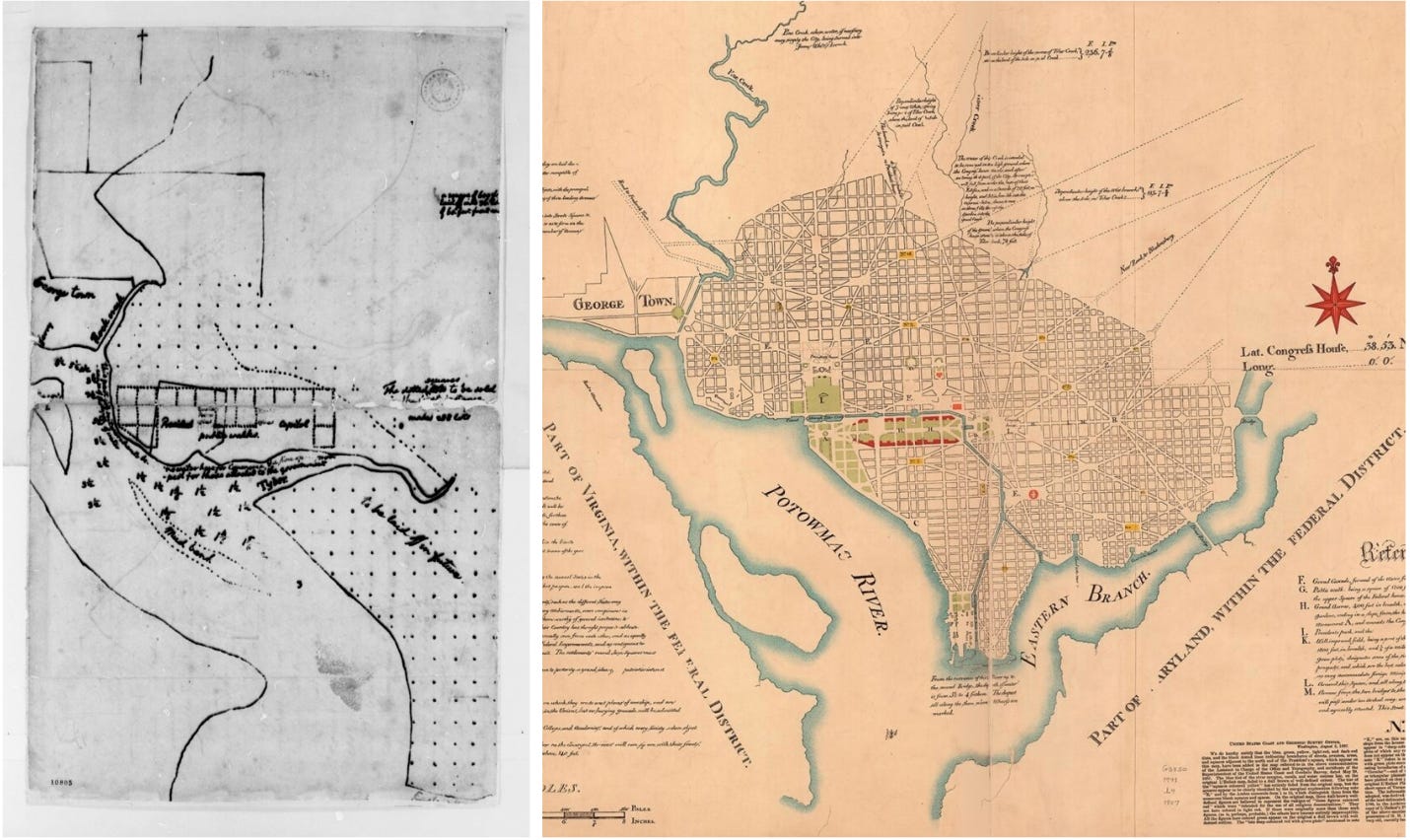
The construction of this great city was itself a commercial endeavor, requiring thousands of workers and millions in financing. Understanding that “money is the wheel to give motion to the machine,” L’Enfant argued that investments in public works, financed by loans secured by federally-owned land, would raise land values and induce development. He suggested that the city could stimulate friendly competition among the states by designating a “state square” for each; similarly, religious institutions could be granted lots to develop rival churches. More immediately, he wanted to discourage speculation and underbuilding by requiring that purchasers of available lots build within a limited time frame. It was an ambitious and thoughtful scheme, one that “would have animated many thousands of hands moving across the site like a great living machine” as they built a city from the wilderness. As L’Enfant’s biographer, Scott W. Berg wrote, “It would have been something to behold.”
It was not to be.

