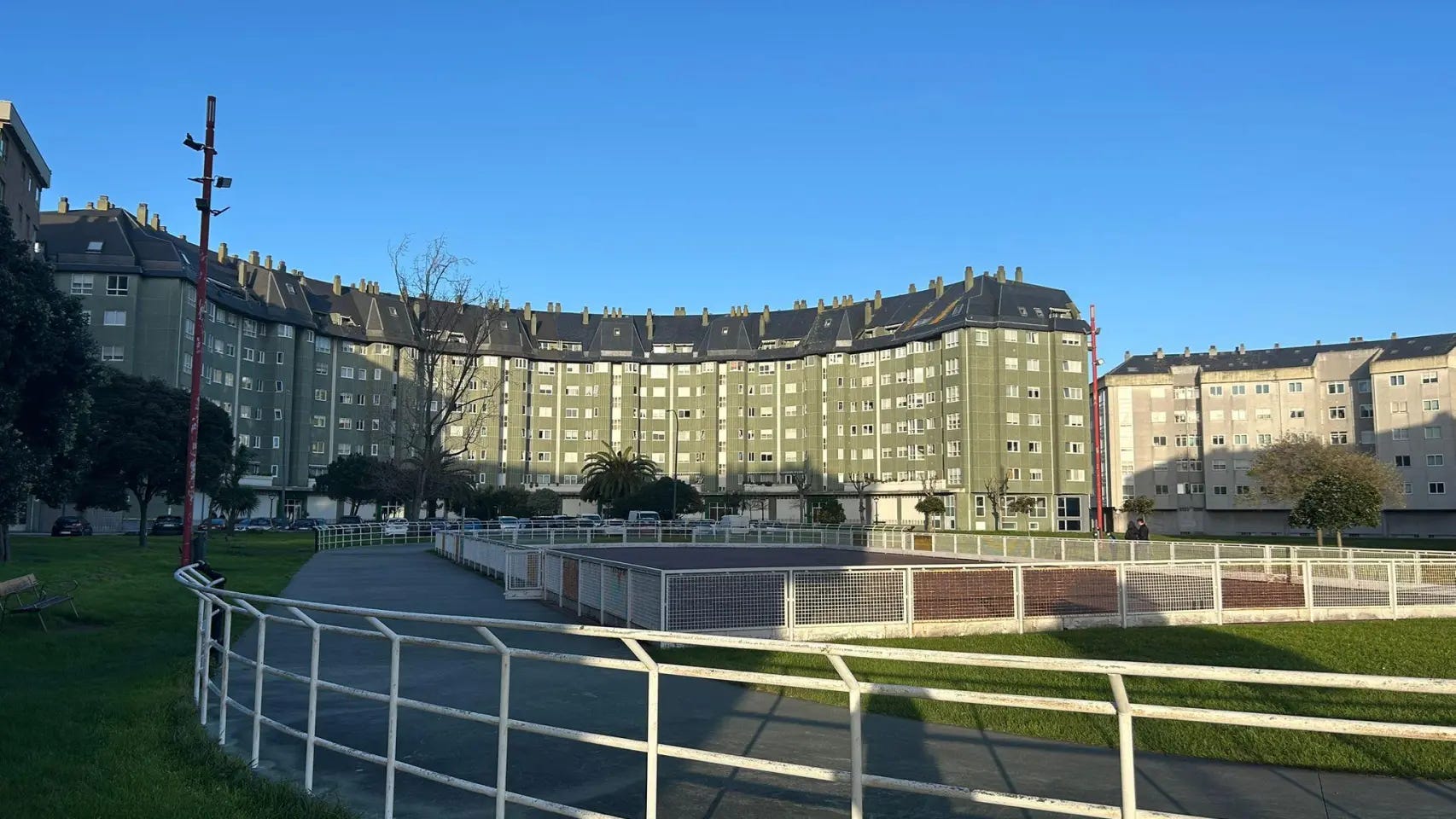


When arriving in A Coruña, in northern Spain, the first thing one notices is not the crystalline blue of the Atlantic as it rolls onto the sandy stretch of the Playa del Orzán. Nor is it the endless galerías, the rows of white glass-enclosed balconies that give A Coruña its nickname, the City of Glass. Nor is it even the nearly two-thousand-year-old Roman lighthouse that still warns passing ships of the rocky shoals around the city. Instead, what strikes the first-time visitor to this midsize city of 250,000 is just how tall everything is. The Spanish news outlet elDiario.es analyzed more than 12 million buildings across Spanish cities and found that A Coruña has the tallest average height of any city in Spain. While you may be imagining Manhattan on the Gulf of Ártabro, the city beats the next tallest city, Barcelona, with an average height of slightly more than five stories.
Height can be deceiving: it is not necessarily an indicator of urban density—and sometimes it can indicate its opposite. This is particularly true of Spain’s postwar development.
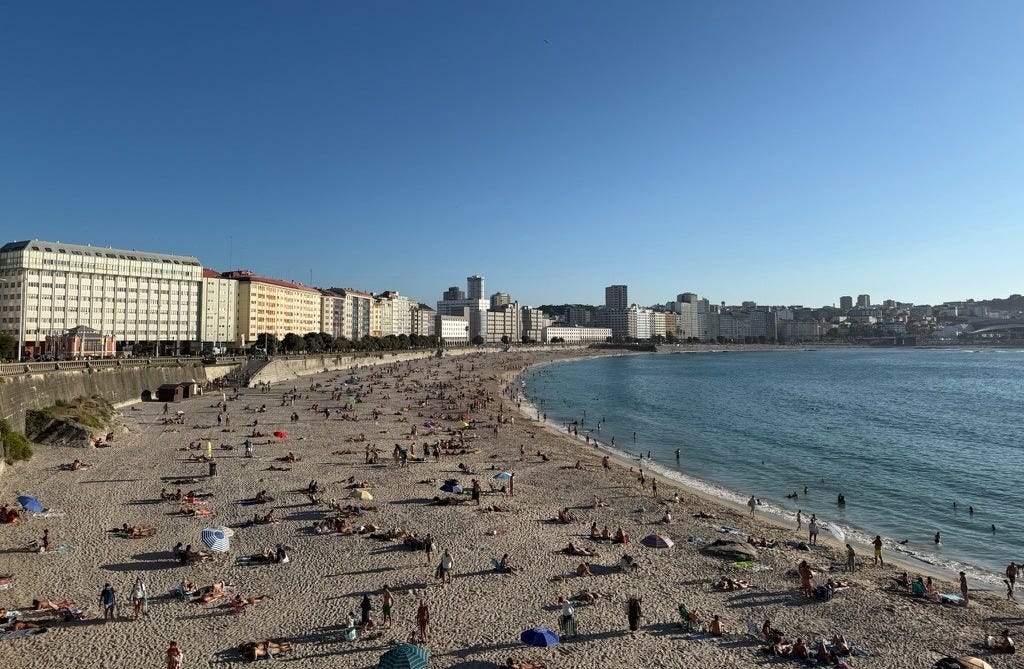
Spain has a well-deserved reputation for having some of the world’s loveliest urban spaces: dense, mixed-use neighborhoods where ground-floor retail lines walkable streets, and where frequent plazas invite you to stop for a coffee or a glass of wine. Such streetscapes are typical in Spain, where 65 percent of the population lives in apartments, more than double the American rate of 26 percent and behind only South Korea’s 74 percent, per the OECD. During my recent visit, I spent time in about a dozen cities of varying sizes, including A Coruña, enjoying the pleasure of being on foot with places to walk to and sit in. But in A Coruña, while walking along its brilliant coastline after visiting the Roman lighthouse, I encountered a neighborhood that offered neither.
Adormideras was constructed in the 1980s as part of a deliberate strategy to keep middle-class families from decamping to suburban municipalities. Instead, Galician modernist architect Andrés Fernández-Albalat designed the neighborhood to bring the suburbs into the city. The neighborhood comprises a series of 8-to-9-story curvilinear apartment buildings surrounded by open space, sports fields, and parking lots. The ground floors of each building used to be storage spaces and have largely been walled off or turned into garages, creating cinderblock walls instead of an activated streetscape. Located on the hammerhead-shaped peninsula that includes A Coruña’s busy centro, municipal transit didn’t connect Adormideras to the rest of the city for years. Four decades later, the neighborhood still has little to walk to other than a municipal market, which received a €2 million European-funded facelift in 2022, but is only open from 9am to 3pm. You still can’t buy a roll of toilet paper on a Tuesday afternoon, as one resident complained. In this “country of bars and cafés,” you have to trek uphill to the livelier Monte Alto neighborhood to find a place to sit and get a drink. The most interesting sight in Adormideras—and perhaps an indication of its remoteness—is the nearby nude beach.
The contrast between the prewar centro of A Coruña and the postwar Adormideras reveals something essential: apartments do not necessarily make a neighborhood urban, just as tall buildings do not necessarily make it dense. Successful urbanism requires connected streets, a mixture of uses, and active public life. If Adormideras seems like an aberration from the classic centro, it’s not unique: Spain has a long history of building exactly this kind of neighborhood.