


The full version of this essay is available to paid subscribers of City of Yes. If you are enjoying the fully free essays, please consider supporting this work with a paid subscription.
In Central Texas, kolaches are a staple of breakfast menus, and hungry Texans gobble them up by the passel. Texans hungry for housing, meanwhile, have turned to the “Texas donut,” a common building type in which a ring of apartments wraps around a multi-level parking garage. In the past decade, Austin built a lot of them—enough to produce something almost unheard of in recent America: falling rents. Once one of the most expensive rental markets in the country, Austin is now cheaper than the national median. But even as donuts proliferated, families were leaving, school enrollment fell, and the district slipped into structural deficits. Austin had served up plenty of housing, but not much that families could live on.
Austin built enough housing to bring rents down. It didn’t build enough to keep families there.
As Pew writes in a new report, Austin built housing at a rate three times that of the national average from 2015 to 2024, adding 120,000 homes—a 30% increase in the housing stock. The result was striking: rents fell even as the city continued to grow, adding another 18,000 people from 2022 to 2024. In fact, Austin appears to have temporarily overshot demand, building enough housing to push rents down despite continued population growth. Critics have pointed to a “glut” of luxury apartments to explain this decline, but the data suggest something else. Rents fell by only 2.6% in newer luxury buildings—and by 11.4% in buildings catering to lower-income renters. As Austin’s high-tech growth machine brought in higher-income workers, those residents moved into new buildings instead of competing for older housing, easing pressure across the market. Few major U.S. cities have built at anything like this pace; in supply-constrained markets like New York and San Francisco, high-income residents are more likely to bid up older housing instead. Most of Austin’s boom, however, took the form of large apartment buildings, which have made up 47% of all homes built since 2015, compared to 25% of detached single-family homes.
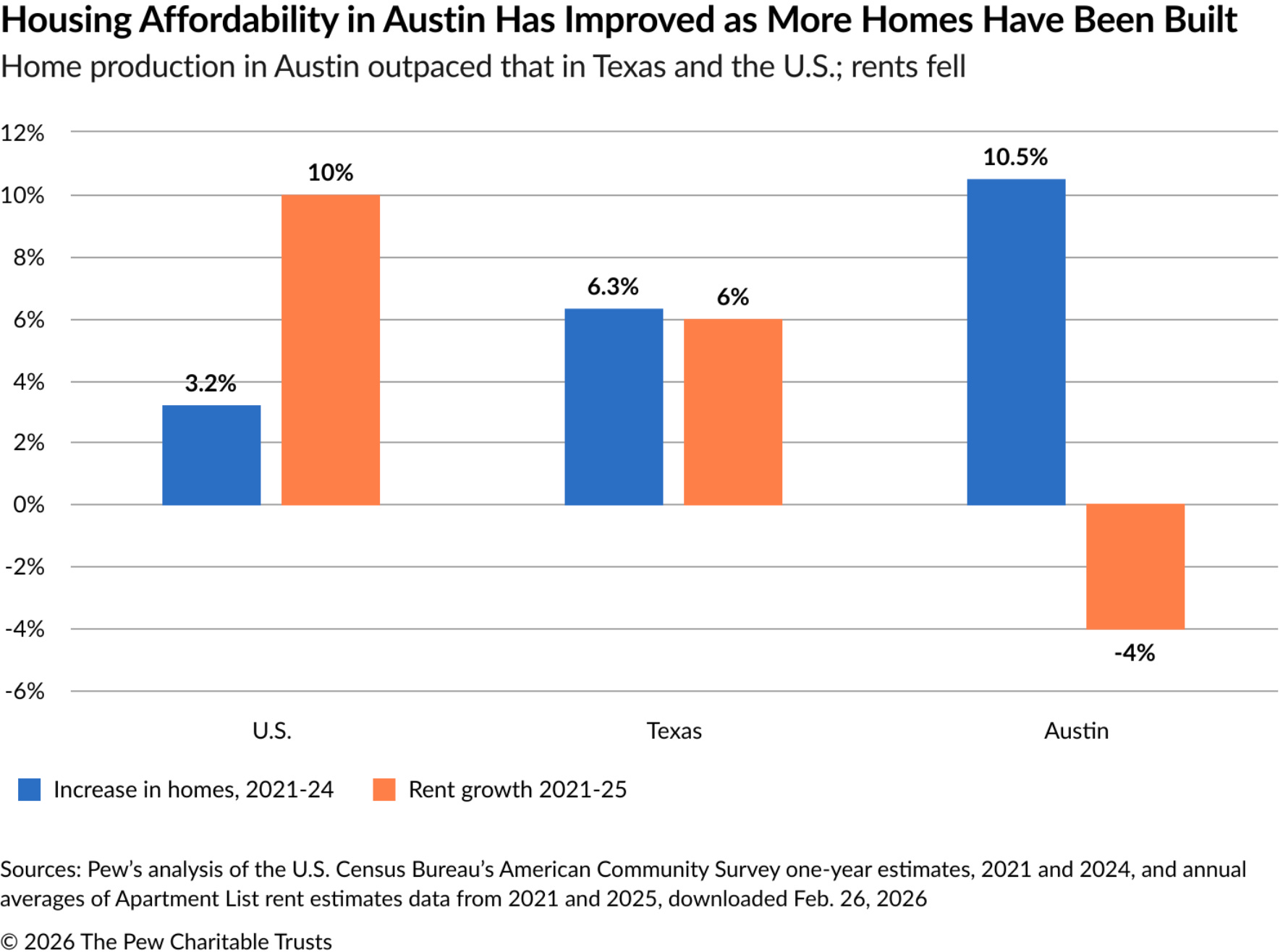
In one sense, this is a clear success: Austin has become much more affordable. On the other hand, the collapse in school enrollments at Austin Independent School District tells a more complex story. Like many cities, Austin saw families leave for the suburbs during the pandemic, but enrollment losses began well before then and have continued since. Indeed, the district lost more than 10% of enrollments between the 2017/18 and 2023/24 school years, but birth rates in the district have been declining since 2015, well before the pandemic. From 2021 to 2024, only 45–47% of children born in the district enrolled in kindergarten. Most did not switch to private schools—they left for the suburbs. Meanwhile, the city’s fastest-growing demographic is residents aged 65 and older, many of whom remain in large single-family homes in the urban core. The central city has increasingly become a haven for wealthy households, retirees, and childless couples. In effect, Austin succeeded in housing its incoming workforce, but in doing so it reshaped who the city is most accessible to.
This isn’t just a story about demographics. It’s a story about what kinds of housing Austin built—and what it didn’t.
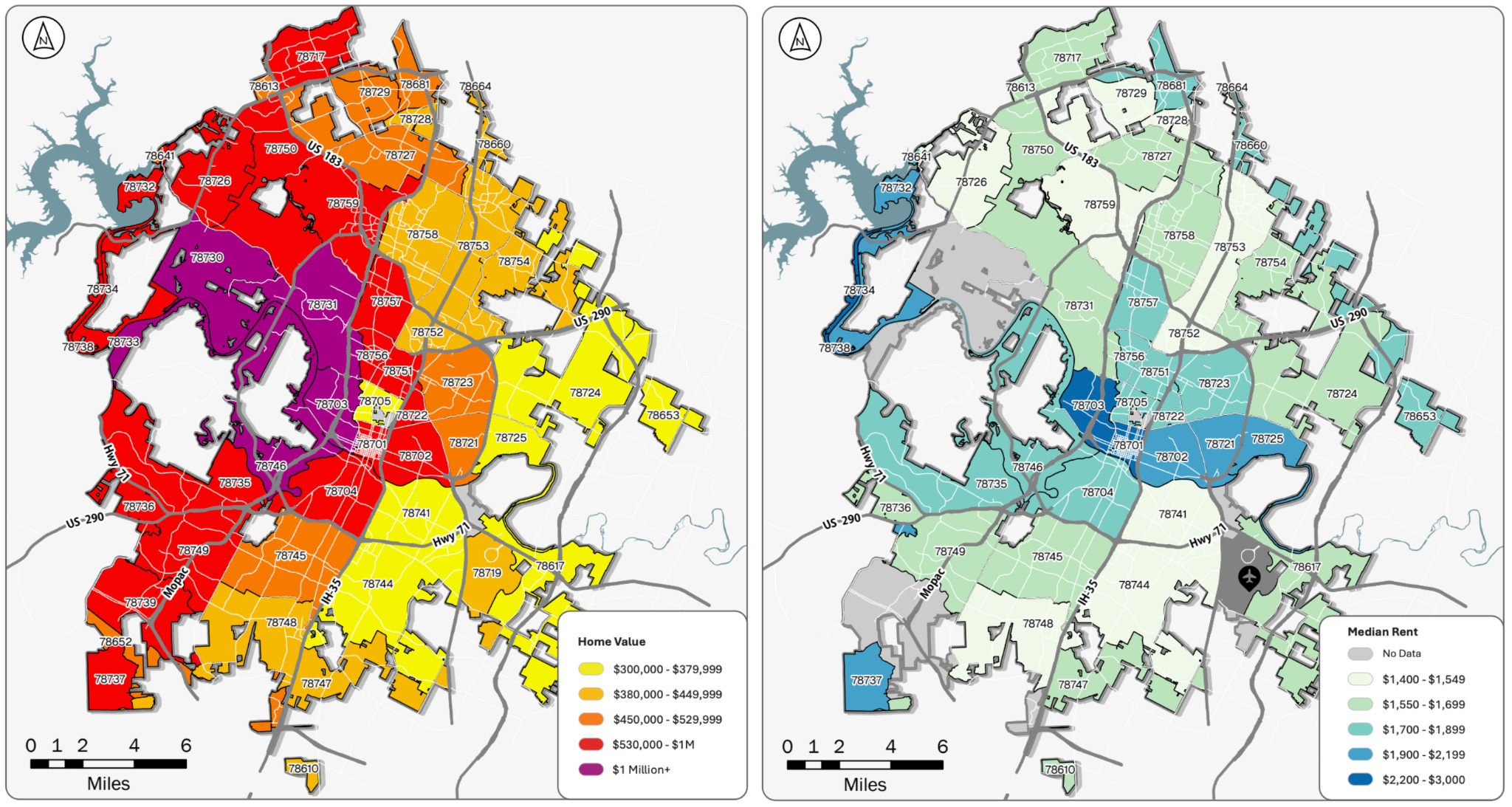
The deeper problem is the cost of family-friendly housing. Austin has plenty of expensive single-family homes and plenty of apartments, but very little in between: townhomes, family-sized condos, and small apartment buildings—the “Missing Middle.” For young families, the available options don’t line up: detached homes are often out of reach, while large apartment buildings rarely offer the space, stability, or path to ownership they seek. Much of the new housing built during the boom has been one- to two-bedroom units in Texas donuts—not the larger, ownership-oriented homes that many families are looking for.
The question isn’t whether Austin built enough housing. It’s why it built so little of the kind families actually need.
