


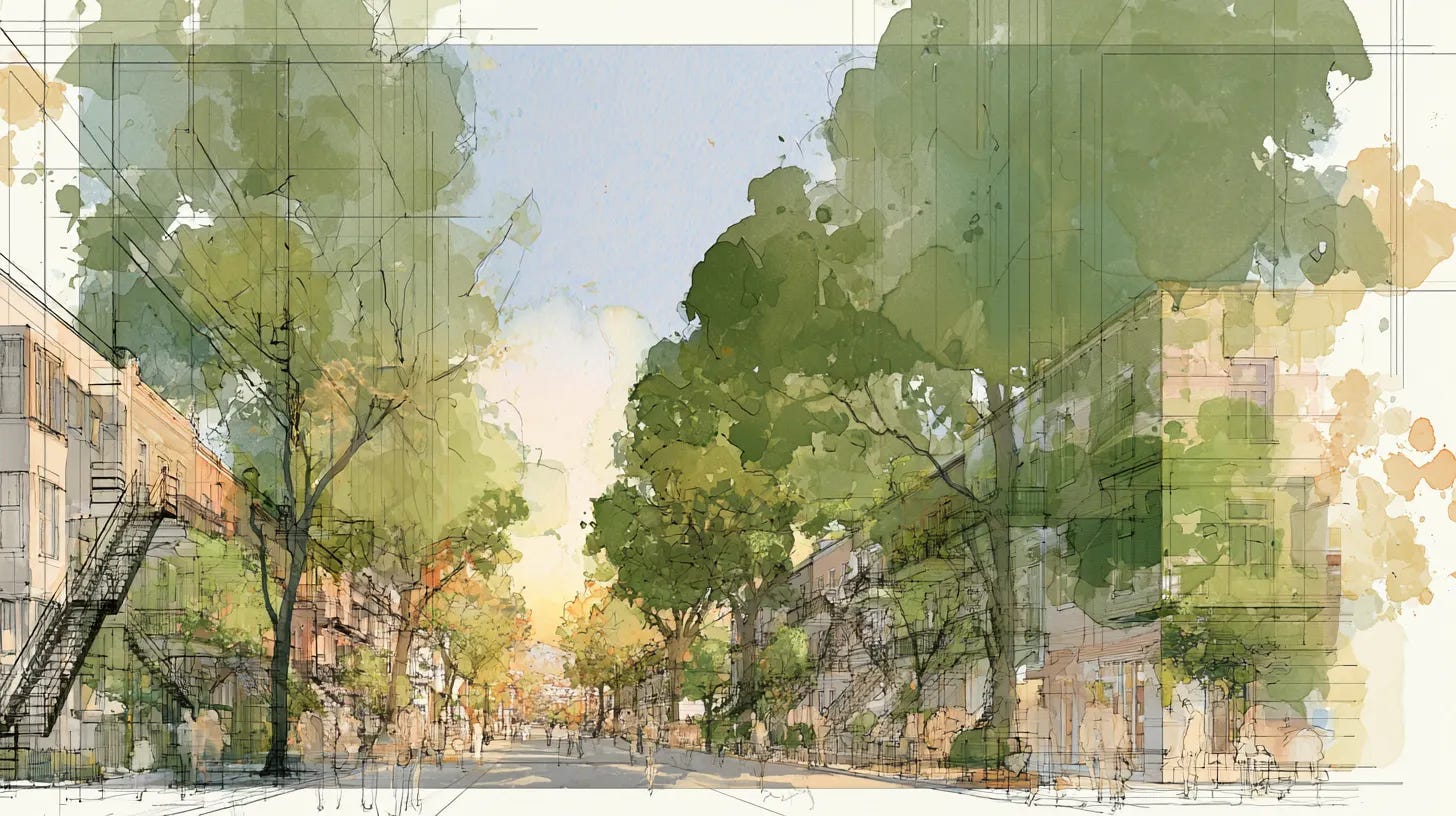
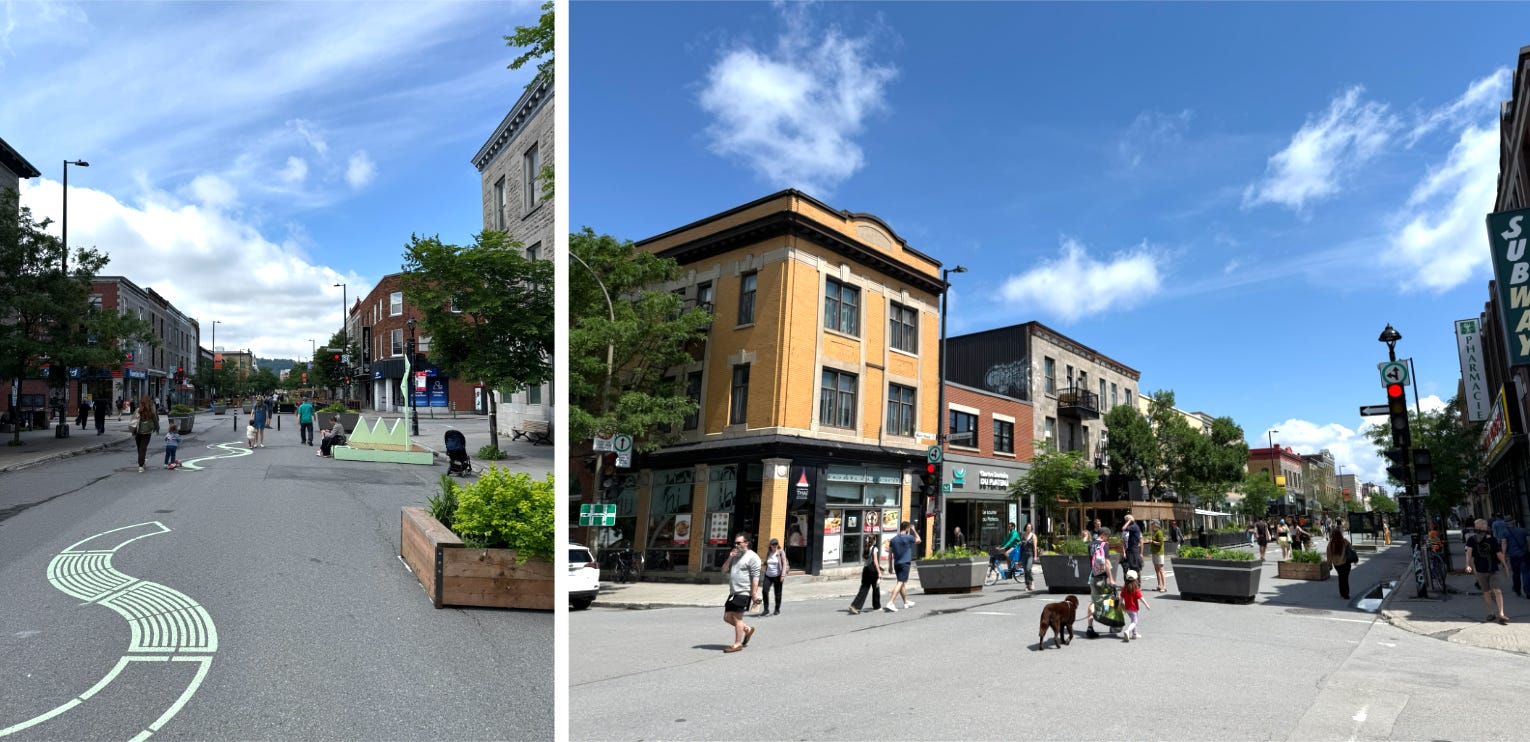
In Montreal, the question of who has the better bagel is one of moral and philosophical significance. Whether you’re a Fairmount fan or Saint-Viateur stan, the great bagel debate is a part of the city’s civic religion, with each shop’s partisans ready to die on a Mont-Royal-sized hill. During a visit to the French-Canadian city, I tried both. While Fairmount was my favorite, Saint-Viateur had the more interesting location, steps away from something perhaps even more controversial: the 2.5-kilometer car-free stretch of Avenue du Mont-Royal. When we visited on a warm, mid-June morning, the Avenue was packed with people: walkers, joggers, cyclists, strollers, and the odd tourist snapping photos of urban infrastructure (moi). Instead of cars occupying its lanes, there were thousands of people simply enjoying a beautiful day.
It was as if this pedestrianized street had been paved for pleasure. Its creation, and its ongoing survival, involved a bit more pain.
Avenue du Mont-Royal is the main commercial artery of the Plateau-Mont-Royal neighborhood, on the eastern slope of the eponymous mountain overlooking Montreal. Plateau itself is densely packed with Montreal’s classic duplex townhouses and well-served by transit, while the Avenue features continuous blocks of commercial and retail establishments, often with a story or two of apartments above. The pedestrianized strip of the Avenue encompasses more than 30 intersections. Where cars once dominated, alternative uses have proliferated. Adirondack chairs in bright colors and lush planters appear in vignettes every few blocks alongside public art. Parking spaces have been repurposed for outdoor dining decks for the plethora of cafes and restaurants—including Saint-Viateur, where we ate outside. The Jardin Nourricier, an edible garden, occupies several former parking spots. Murals add splashes of color to the streetscape. On a beautiful morning, sated with bagels, it was hard to imagine that any of this required a fight.
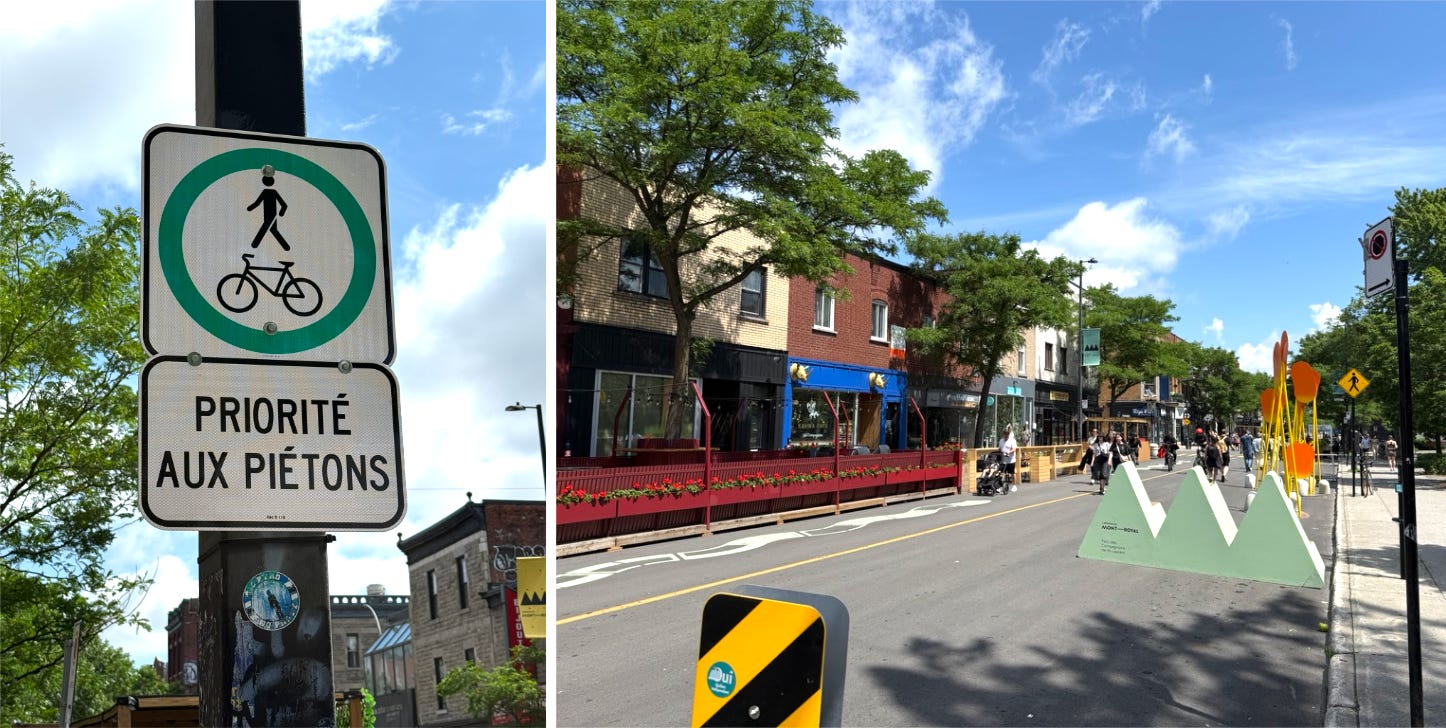
What seems like such a natural neighborhood resource is a more recent invention, an outgrowth of Covid-era indoor capacity limits. Pedestrianization of the Avenue was a long-term dream of Projet Montréal, the left-of-center party that has long-governed Plateau. Montreal’s local politics made the dream possible: as a local commercial street under Montreal’s governing structure, the Avenue is controlled by the borough (arrondissement). This urban wonderland, teeming with human life, is only open from late May through mid-October, mostly on account of Montreal’s forbidding winters. Every October, the whole thing must be disassembled and rebuilt in the spring. Despite its apparent success, it must be annually reaffirmed, refunded, and renewed. Why?
Because pedestrianization projects—often called pedestrian malls—have a long history of outright failures and middling results.
Time and time again, cities have made the mistake of assuming that pedestrianization simply meant closing a street to cars. But removing cars does not automatically create a walkable environment that generates foot traffic. Indeed, many cities that created pedestrianized malls failed to realize that a thriving pedestrian street is the culmination of preexisting urban vitality, not its cause.
That includes Avenue du Mont-Royal. The first attempt to pedestrianize the Avenue began in the summer of 1970 but fell out of favor by the freezing winter of that year, after which it was abandoned. A grassroots campaign in 2002 garnered 20,000 signatures for a permanent car-free avenue that was ignored by local authorities. The local business community, no doubt aware of the long history of failed pedestrian malls, opposed the change. Nevertheless, borough mayor Luc Ferrandez spent the decade from 2009 to 2019 installing pedestrian-friendly improvements around the borough that gradually softened that resistance. The rapid onset of Covid precipitated an emergency for restaurants and retail, and people suddenly looked on their streets and saw space that could be used for social distancing. The borough government designated a stretch of Mont-Royal as a “health corridor” (cordon sanitaire) but, notably, did not simply close the Avenue. They hired architecture firm Intégral Jean Beaudoin to holistically rethink this new public space, incorporating seating, public art, and greenery into the design.
During my visit in June, it was easy to see how popular the pedestrian mall is with locals. Estimates place daily pedestrian traffic around 15,000, while a survey by the local business association cites 90%+ visitor approval. Local merchant sentiment is generally net-positive: a 2024 survey found that 43% of merchants saw sales rise during pedestrianization, while 30% experienced a decline, generally businesses that were car-dependent or lacked patio dining. The more telling number is commercial vacancy, which fell from 14.5% along Mont-Royal in 2018 to 5-to-6% by 2023.
Street pedestrianization is not free. The annual budget for transforming Mont-Royal is about $1 million, split 60/40 between the local government and business association. Still, for the first several years, the project had to be approved and funded anew every year. The city committed to a three-year renewal through 2027, after which the Avenue will once again have to requalify. There is an ongoing debate about whether to make the season longer or shorter, or even permanent, despite the fact that winter is always coming in Montreal.
Mont-Royal therefore raises a more revealing question: not why so many pedestrian projects fail, but why so few succeed.
Pedestrianization emerged in the midcentury era as an attempt by cities to compete with suburban malls. Between 1959 and the early 1980s, American cities made more than 200 pedestrianization attempts. But by the early 21st century, most had failed, with less than two dozen remaining. The first attempt, Kalamazoo’s 1959 Burdick Street mall—designed by Victor Gruen, the inventor of the modern suburban shopping mall—was partially reopened to car traffic in 1998. Philadelphia’s Bicentennial-era Chestnut Street Transitway, which allowed buses on a car-free stretch of twelve blocks, became a pedestrian repellent dominated by bus fumes and noise until it was reopened to cars in 2000. As Alan Ehrenhalt writes, most of the surviving pedestrian malls were in cities with fewer than 100,000 people.
In all places, the predictors of failure were the same: the streets that were chosen for closure to cars were primarily destinations for drivers. Located in downtowns that were already in decline, they had insufficient parking for visitors, no residential density, no tourism draws, and emptied out at night and during inclement weather, which bred negative perceptions about crime and safety, and further reduced foot traffic. While year-round malls have been most successful in cities with accommodating year-round weather, the ingredients of successful malls are generally pre-existing foot traffic, transit access or sufficient parking, anchor institutions like universities, stadiums, or convention centers, and a mix of all-day pedestrian-friendly retail and restaurants.
The pedestrian malls that survive in America today often look a lot like what Victor Gruen achieved with his original suburban shopping mall. After two decades of struggle, Santa Monica’s Third Street Promenade found its footing as an open-air national chain store mall—popular with tourists, close to the beach, but otherwise lacking in local flavor. Miami Beach’s Lincoln Road Mall went through a long period of doldrums following its initial success as the city itself declined in the 1970s, finding revival with the emergence of an artistic community in the 1980s that is now running up against high rents and replacement by national brands. Montreal’s Mont-Royal, with its density, its transit, and its deference to winter, has so far avoided both fates, retaining its distinctly local flavor—one that tastes a lot like bagels.
Pedestrianized streets are a staple of European cities and the envy of every North American visitor, from Copenhagen’s Strøget to Barcelona’s historic La Rambla, new Consell de Cent green axis—or its nearly entirely pedestrianized Gothic Quarter. Indeed, Spain seems to do pedestrianization effortlessly in its historic centros. On a recent trip to Spain, I spent time in about a dozen cities ranging in size from a couple thousand people to several hundred thousand to Madrid’s 3.5 million, enjoying pintxos and vino tinto in many of them. Each had largely pedestrianized centros where cars weren’t needed at all for accessibility thanks to nearby transit or the walkability engendered by residential and hotel density, or parking lots located just outside the centers for visitors.
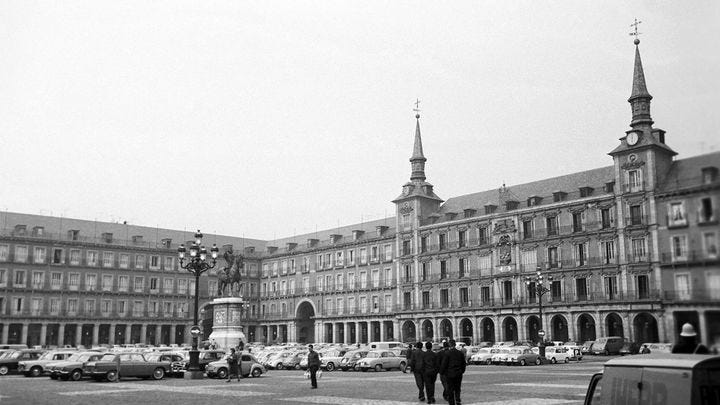
Yet these apparently effortless pedestrian districts are not accidents of history. The Strøget was pedestrianized only in 1962. Madrid’s Plaza Mayor was a parking lot in the 1960s. Barcelona’s superblock green axes only emerged in the past decade. Pedestrianization is a choice to remove cars—but whether what gets pedestrianized succeeds depends on the urban fabric around it. In the European examples, the pedestrianized streets were already surrounded by mixed-use, dense, lived-in neighborhoods where walking was useful and effortless rather than incidental or recreational. The foot traffic already existed, even if it had to compete with cars for space.
What many American downtowns have historically lacked is the density of permanent residents and the existence of amenities that give people something to walk to. Zoning determines whether enough people can live within walking distance or whether there can be a mix of uses. Transit determines whether visitors need to arrive by car. Street design determines whether an urban environment is intended for pedestrians or vehicles. Too many American pedestrian malls reversed cause and effect. Cities thought that by removing the cars, vitality would reemerge, not understanding they had already erased the conditions that made vitality possible.
Montreal’s Plateau did not become a walkable neighborhood because Avenue du Mont-Royal became car-free. Instead, Avenue du Mont-Royal could become car-free because Plateau was already a walkable neighborhood.
City of Yes is a reader-supported publication. If you find this work valuable, please consider becoming a paid subscriber. Thank you for your support!
You're in Canada. They're called Muskoka chairs.
Adirondack chairs are slightly taller with a flat back and wider armrests, while Muskoka chairs are lower, feature a curved back, and have a more compact armrest design.
My culture is not your costume.