


This is the fifth and final essay in our month-long series celebrating 250 years of American urbanism at City of Yes. Today’s essay is free for everyone thanks to the paid subscribers who make this work possible. If you’ve enjoyed this month’s exploration of the commercial republic, the best way to support more of it is with a paid subscription. Thank you for reading!
One hundred million people were expected to descend on Philadelphia in 1976 for a year-long celebration of the city where the American experiment began. Two centuries after the Declaration of Independence made the city sacred ground in the American imagination, Philadelphia planning director Edmund Bacon proposed a Bicentennial celebration worthy of the occasion. Philadelphia would showcase its remade historic core, host a world’s fair, redevelop its waterfronts, pedestrianize Chestnut Street, and carry visitors across the Schuylkill by aerial tram. A rival coalition went further, proposing a four-mile megastructure constructed above the Pennsylvania Railroad yards. What got built turned out to be far more modest, and by the end of the year, fewer than 20 million people had come to the Cradle of Liberty to celebrate.1
Arriving amid economic stagnation, racial conflict, antiwar protest, and urban disorder, the Bicentennial was meant to be a transformative and unifying event at a moment when trust in the American project seemed to be unraveling. Its failure to live up to expectations also revealed how dramatically Americans’ understanding of the American city had changed since the republic’s founding.
Over the past month, we have explored the forces that animated the cities of the early republic. We found cities where the spirit of commercial enterprise, unleashed by immigrant financiers like Hamilton and Gallatin, energized a cosmopolitan, upwardly mobile populace; where civic entrepreneurship, exemplified by Franklin’s Junto and subscription library, led to the foundation of long-lasting institutions and the democratization of knowledge; where a replicable, affordable housing type, the rowhouse, enabled the rapid growth of an urban middle class; and where ambitious planners, L’Enfant chief among them, attempted to imprint a commercial spirit into urban streetscapes. Each story seems to belong to a different history: economics, politics, architecture, planning.
In fact, each was animated by the same conviction: that the republic would be built not only in statehouses and constitutional conventions, but in the physical fabric of the city itself. As historian Dell Upton writes, elites of the early republic believed that order “arose from within, from the character of its citizens, rather than being imposed by a higher authority.” The city was a tool of that formation—pursuing both “civilization,” the making of citizens, and “urbanity,” the cultivation of orderly relations among neighbors. If a free people could govern themselves within the bounds of law and the Constitution, then cities, too, could be organized according to the same republican logic.
In the physical city, that logic found its clearest expression in the grid. The grid was valuable not merely because it simplified surveying and real estate transactions, but because it made the city transparent: easy to read, easy to navigate, and open to everyone. Within this open society, capital could flow and commercial enterprise and civic entrepreneurship could flourish. Such a city presented opportunities rather than prescribing outcomes, making countless futures possible for its citizens—and making countless citizens. As Upton puts it, “The systematic city was above all a dynamic city.”2
This wasn’t only a Philadelphia story, but as “the intellectual as well as the commercial capital of the new republic,” Philadelphia became its crucible. This was not by design. William Penn and Thomas Holme’s original plan for the city was hierarchical, meant to be populated evenly from the Delaware to the Schuylkill under the authority of the city’s wealthy proprietors. Instead, in its first century, Philadelphia grew largely in defiance of that plan: commerce favored the Delaware waterfront, squares reserved for public use were subdivided and built over, and after nearly a hundred years only ten of Holme’s 176 planned squares had been fully developed. By the early nineteenth century, however, elite Philadelphians rallied around what reformers called “the ground plan...as laid out by the worthy founder,” leveling streets and regularizing squares to bring the long-neglected grid closer to Holme’s original map. What looked like a restoration of Penn’s plan was, Upton writes, actually “a revolutionary new urban vision”—the grid reimagined not as a hierarchy but as “a template for the relationships of a diverse, more loosely ordered citizenry.”3
Call it Philadelphia Freedom.
As immigration and industrialization transformed American cities over the course of the nineteenth century, however, urban leaders increasingly came to regard that freedom as the city’s greatest weakness. Smoke belched from factories, blood spilled from slaughterhouses, and soot stained buildings. Housing lacked running water and windows, families crowded into rooms, disease festered and spread. The streets were crowded with workers, businessmen, and shoppers alongside horses, carriages, streetcars, and trains—all dodging human and animal waste. Political machines made corruption, not commerce, the new coin of the realm. Reformers, confronting real crises, initiated programs to build sewers, sidewalks, and parks. They implemented building codes and sanitation standards. They pursued civil service reform and public improvements, seeking efficiency in government and beauty in the city itself. Along the way, they lost the idea that civic order could emerge from free citizens, and increasingly concluded that it had to be imposed by experts. The city was too complex to leave in the hands of citizens.
That new philosophy found several expressions in the late nineteenth century. Riding on the success of the 1893 World’s Columbian Exposition in Chicago, the City Beautiful movement sought to cultivate civic virtue through monumental design, imposing, for instance, a Monument City onto L’Enfant’s commercial streetscape in Washington, D.C. The new profession of city planning promised to organize the metropolis scientifically. The first comprehensive zoning codes no longer treated the city as an open framework; whereas the egalitarian grid left uses and outcomes largely open, zoning circumscribed those possibilities, sorting, segregating, and prescribing uses in advance. Together, these movements reflected a growing suspicion that the emergent city was incompatible with an orderly one.
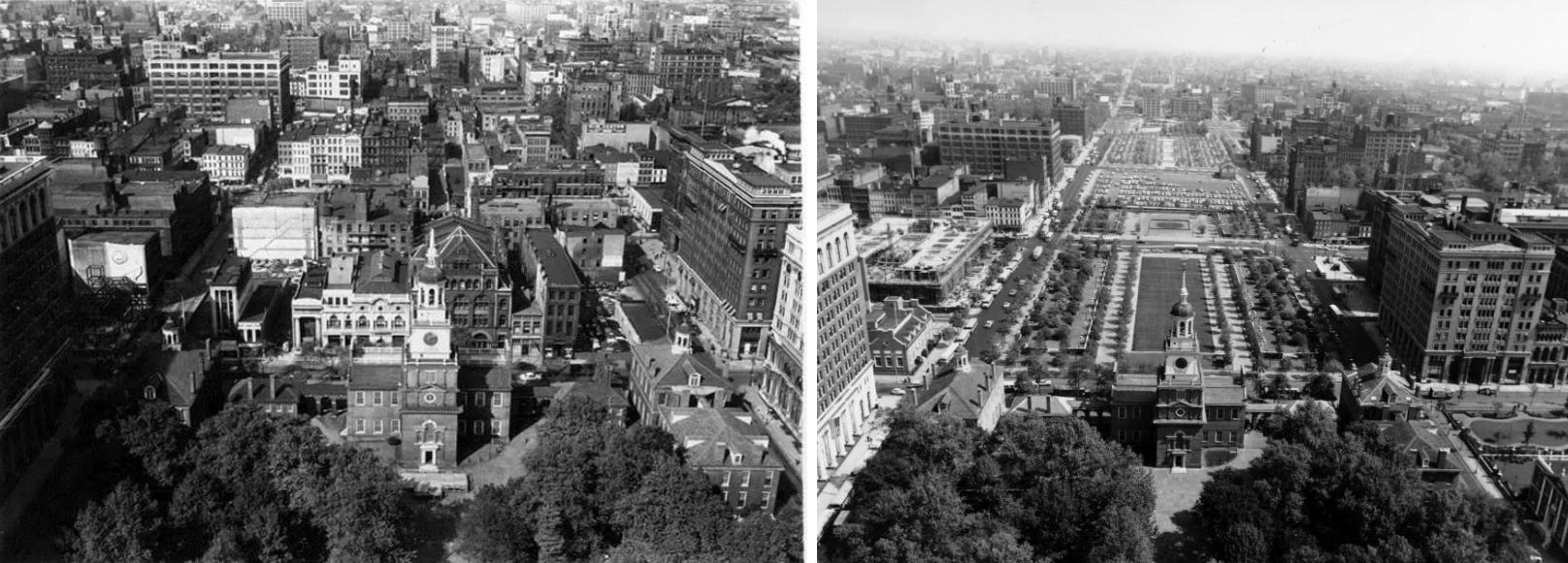
Edmund Bacon inherited this tradition in Philadelphia—but he also inherited a city in genuine distress. After World War II, Philadelphia’s industrial economy had been hollowed out, middle-class households and capital were fleeing to the suburbs, its housing stock had deteriorated, and its historic center was increasingly seen as obsolete. Bacon’s answer combined elements of strategic preservation with wholesale erasure. In Philadelphia’s historic core, the neighborhood that planners renamed Society Hill contained one of the country’s richest concentrations of eighteenth- and nineteenth-century buildings, and a racially and ethnically mixed population of mostly working-class renters. To urban renewers, it was a slum; to the people who lived there, it was home.4 As Society Hill’s historic houses were restored, much of the mixed-use city of warehouses, workshops, and markets was cleared away, along with nearly six hundred families, one-fifth of them black.5 Nearby, Bacon completed a vision that Beaux-Arts planners had floated since 1917: clearing three densely built blocks north of Independence Hall to create Independence Mall, while demolishing buildings around the surviving revolutionary landmarks to isolate them as monuments.6 The result made Independence Hall more visible to tourists but less intelligible as part of the living city that the founders would have known.
Having already remade the revolutionary historic city, Bacon’s Bicentennial plans were the logical culmination of his work. He would use the nation’s anniversary to reshape the city on an even larger scale according to a comprehensive vision of what Philadelphia should become. Instead, political disagreements, congressional investigations of President Nixon’s Bicentennial Commission, and limited funding reduced the scope of the city’s plans. By the time 1976 arrived, neither Bacon’s plan nor its more ambitious successor had been built. The city welcomed the nation with refurbished landmarks, museums, sporting events, street festivals, and the much diminished Chestnut Street Transitway—a bus-only pedestrianized mall that ultimately failed. What visitors encountered was not a city remade for the future so much as a curated version of the city inherited from the past: Independence Hall and the Mall, the restored houses of Society Hill, the Delaware waterfront. Philadelphia celebrated the republic in the fragments of the old commercial city that had survived three centuries of growth—and the twentieth century’s repeated attempts to “improve” it.
Such is American urban history.
When Ben Franklin stepped out of the Pennsylvania State House after the Constitutional Convention in 1787, he was asked what kind of government had been created. As he walked the few blocks home from what today we call Independence Hall, he would have passed through a dense streetscape of brick and stone buildings containing stores, homes, and workshops along streets thronged with people. He would have passed fellow citizens engaging in the life of the city: merchants closing deals on a handshake, apprentices setting type in a printshop, neighbors trading news and gossip on their stoops. Here, on its streets, was a city in motion, making and unmaking itself again, ordered but unfinished. When he answered, “A republic—if you can keep it,” he would have seen the new republic already emerging all around him in the streets of Philadelphia. Here was where the citizens of the new republic would be made.
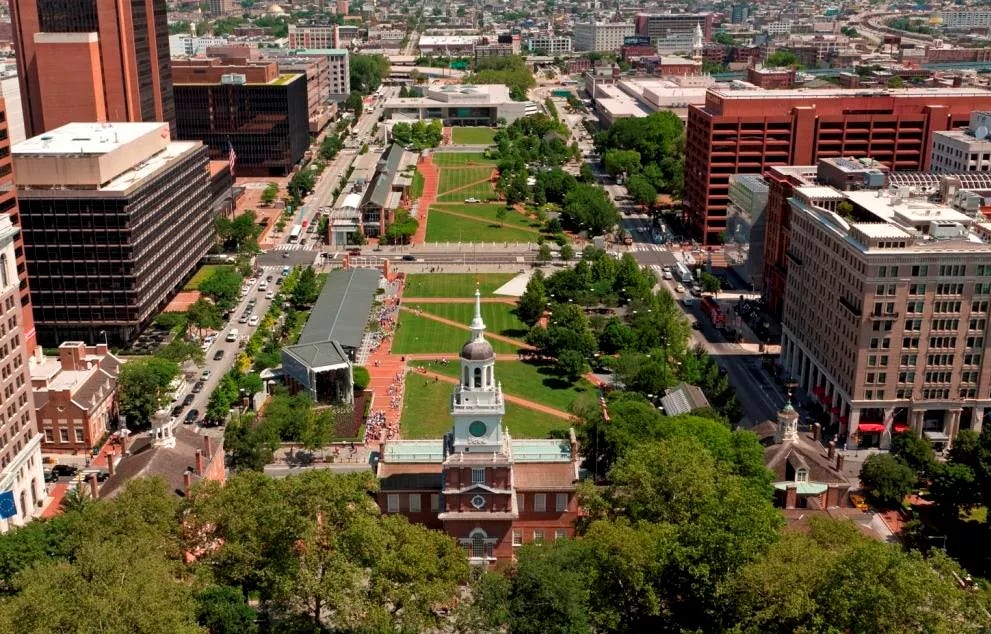
If Franklin walked out into the Philadelphia of today, he’d find a great, ceremonial lawn with sweeping views of Independence Hall, swept clean of the commercial and civic life that had produced it. In alienating the revolutionary buildings from their historic urban context, the midcentury planners alienated future generations of Americans from their history. Buildings once embedded in the fabric of everyday urban life became monuments to be gazed upon, relics of a past republic whose cities generated civilization and urbanity. Today, Franklin might ask a different question than the one he answered in 1787: not whether we can keep the republic, but whether we can still build cities that make citizens.
Philadelphia Freedom wasn’t free, but City of Yes stays mostly free thanks to the paid subscribers who support this work financially. If you find this work valuable, please consider upgrading—and enjoy 25% off!
“Bicentennial (1976),” Encyclopedia of Greater Philadelphia, https://philadelphiaencyclopedia.org/essays/bicentennial-1976/
Dell Upton, Another City: Urban Life and Urban Spaces in the New American Republic (New Haven: Yale University Press, 2008).
Ibid.
George W. Dowdall, “Society Hill,” Encyclopedia of Greater Philadelphia, https://philadelphiaencyclopedia.org/essays/society-hill/
“About the Project,” Preserving Society Hill, https://preservingsocietyhill.org/about-the-project
Cynthia MacLeod, “Creating Independence National Historical Park,” National Center for Preservation Technology & Training, National Park Service, https://www.nps.gov/subjects/ncptt/creating-independence-national-historical-park.htm
Give a planner the power of eminent domain, what tragedies become possible!
Again you pick my favorite founding father. Franklin wouldn’t recognize Philly today, but I still love it.