

Repost: Jerry's Apartment
In Defense (and in Search) of the Elusive Pop-In


Hi. I’m traveling in Japan this week, so I’m resurfacing an essay I wrote in 2024 that feels newly relevant after last week’s “The Age of Assholes”. Enjoy—and I’ll see you next week with some thoughts on Japanese urbanism. —RP
Cosmo Kramer is perhaps the world’s worst neighbor. Inconsiderate of personal space and prone to explode through Jerry Seinfeld’s door at any moment, he’s a caricature of what non-city people imagine urban life is like—loud, intrusive, literally on top of each other. On the other hand, Seinfeld presents Jerry’s apartment as a sort of urban refuge, a place where his friends George and Elaine can easily and effortlessly “pop in” to gossip and kvetch and overshare. They enjoy the kind of regular social interaction that makes their little group cohere, even if they collectively exhibit a “callous indifference and utter disregard for everything that is good and decent.”1
Not that there’s anything wrong with that.
While Jerry confesses to hating the pop-in, it’s something of a trope in television. In Will & Grace, Jack fabulously sashays his way into Will and Grace’s apartment. In Friends, Monica’s ludicrously large illegal sublet is the nexus for her sextet and Phoebe’s pop-ins. Or Kimmy Gibler bursting into the Tanner home on Full House, Urkel irritating the Winslows on Family Matters, and Barney Stinson barging into Ted’s apartment on How I Met Your Mother.2
The trope is largely a made-for-TV myth.
Real adult life is largely bereft of the pop-in friend—and I think it might be for the worse. When we lived on West 44th Street in Manhattan, we had one friend who would occasionally buzz up after getting a haircut in the salon in our (smart, walkable, mixed-use) building. These visits involved no planning, no expectations, nothing more than a few moments to catch up and enjoy each other’s company. And for those moments, they made a big, often anonymous city feel a lot more intimate and accessible—these pop-in visits made our lives better and our friendship stronger.
But if our friend’s salon hadn’t been in our building, how likely is it he would have gone forty-five blocks out of his way to pop in otherwise? He was the exception that proves the rule.
The kind of low-effort socialization portrayed in Seinfeld and other shows is exceedingly rare in real life, but it’s something I’ve been craving more of, especially in these post-pandemic days of working from home. I know I’m not alone in feeling that way. I thought we might get closer to it when we moved to Austin, joining a group of friends who had found their way here over the years. Instead, the reality was that most of our friends who “moved to Austin” ended up in its suburbs, and pop-ins aren’t likely to happen when there’s a 45-minute drive each way.
But it’s not like we see the friends who do live nearby all the time, either. Getting together at all often requires a couple weeks’ notice, coordinating reservations, menus, babysitters—it’s an event, and events must be planned. Most of us won’t find that too shocking, but is it necessary…or even normal? Kirsten Powers shares a striking anecdote from Italy that suggests it might not be:
While in Trieste, I signed up to take one-on-one Pilates classes from an Italian woman in her late 30s. As I shared my frustrations about life in America, particularly how lonely it could feel, she asked me how often I saw my friends. “About once a week,” I said, even though as I said it, I realized it was much less.
She was shocked. “This is not normal,” she said. “I see my friends every day.” She explained that when she left that evening, she would stop to see her friends as she walked home—a glass of wine with one, perhaps dinner with another.
None of this was planned in advance.
If you showed up at someone's house in Washington, DC, unannounced, you would be considered a sociopath.
In America, we do not live in the land of the free-to-pop-in.
In the case of the characters from Seinfeld, sociopathy might indeed be implicated. But it’s interesting that so many sitcoms rely on this trope despite its apparent antisocial connotation in American life. Of course (spoiler alert), TV is not real life. TV sitcoms require continuity of place and consistent casting for budgetary and narrative reasons, so it’s not surprising that prime-time regularly shows prime-age adults engaging in something largely unfamiliar to the average viewer.
But the idea of popping in at Jerry’s apartment—or Monica’s, or Will and Grace’s, or Ted’s—appeals to we-the-viewers nonetheless. I don’t think it’s because Hollywood has acculturated us to some foreign ideal, but rather because the presentation of friendships in these shows is inherently appealing. We, too, wish to experience the effortless pleasure of regularly being around people we love.
And yet it is something we seem incapable of replicating offscreen. As Seinfeld might ask, “What’s the deal with that?”
Perhaps it’s that, in a world of same-day delivery, swiping left and right, and Zoom therapy—a world in which we have optimized effort away—we’ve come to expect everything else to be effortless, including relationships. Or maybe we’ve forgotten how to put in the work. Rosie Spinks suggests we're suffering from “social atrophy”:
We are so burned out by our data-heavy, screen-based, supposedly friction-free lives that we no longer have the time or energy to engage in the kind of small, unfabulous, mundane, place-based friendships or acquaintance-ships that have nourished and sustained humans for literal centuries.
Technology didn’t change our need for social nourishment and sustenance. And those “literal centuries” were not ancient history. Indeed, for many of us, the pop-in was a feature of our youth. Remember the neighborhood kids who would pop in at your front door to ask you to play, or the college students who would pop into your dorm room for a casual chat at 3 a.m.? I suspect it is also a feature that returns in retirement. Until she died in 2023, my grandmother would regularly grab a screw-top of white wine and pop in at her friend’s house across the street. So I don’t think we have some innate aversion to the pop-in; rather the opposite, it seems.
Something happens in adulthood between college and retirement that makes us forget how to have these easy relationships. It would be easy to blame it on kids and career, but many if not most friends my age and older are at a point in their careers where they largely control their time, and it’s not like my childless friends are popping in at each other’s homes, either.
So what’s the deal with us? Did changing work patterns and social expectations, ossified land use policies that discourage walking, revolutionary smart phones, disruptive social media, or a global pandemic alter our behavior? Or do we actually have to live much closer to our friends to make it happen?
Or was Jerry’s apartment a place you could only ever really pop in at in TV Land?
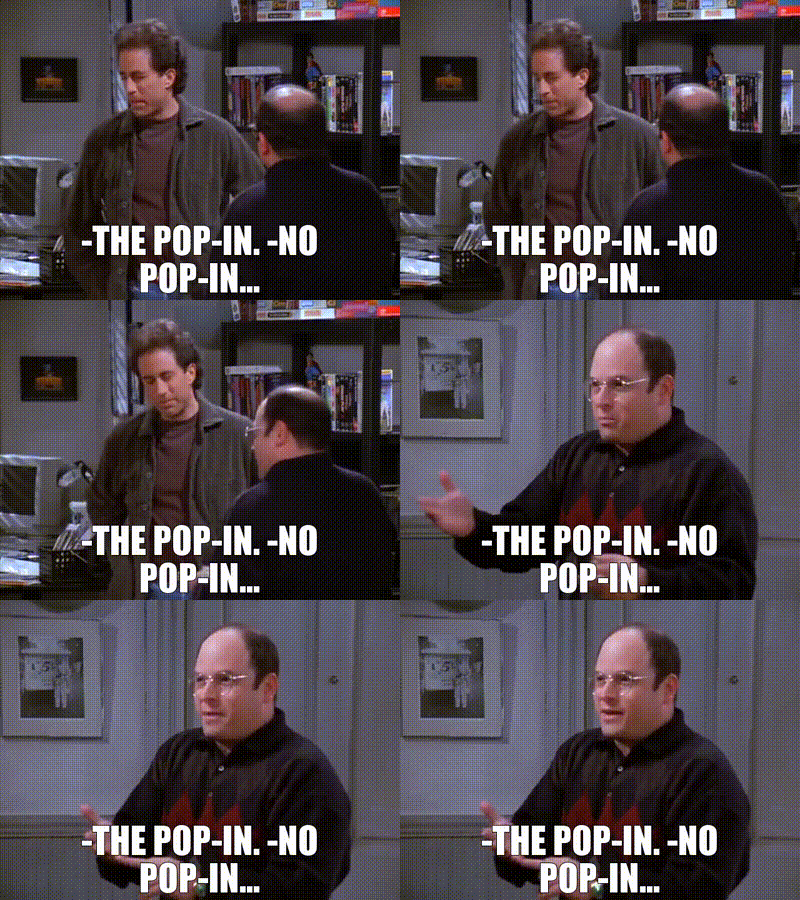
We can’t fully blame the paucity of pop-ins on land use policy, mid-life logistics, or other exogenous factors, though they all add friction that makes the pop-in rarer than it might be. Instead, we have to look inward: you’ve got to have both the willingness to pop in as well as the willingness to be popped-in on—that’s the missing social sinew that seems to keep us from flexing this muscle. Which is a shame, for the pop-in offers a possible low-stakes remedy for strengthening our social wellness at a time when our in-real-life connections have gotten weaker. As with any exercise, it might hurt at first, but the heavy lift gets easier each time you try it.
Reclaiming those “small, unfabulous, mundane, place-based friendships” that nourish and sustain us—the kind of effortless friendships we see on TV—requires somebody to make an effort. Is anybody up for a pop-in?
Want to pop in? Challenge accepted!
Maybe I’m thinking about this wrong, but whether it’s Italy, or Spain, or Mexico City (where I lived for a few years, it wasn’t always the “pop-in” (which did happen of course occasionally), but there was usually a desire to get out, and walk around (the paseo is a well known example) where you were sure to bump into someone who was also interested in chit-chat for chit-chat’s sake… To me, that is the lesson of walkable neighborhoods and centralized gathering places - if you crave social interactions, you know where to go!
I am obsessed with this very subject: how did we get to a state where dropping in is considered rude or worse? Thanks for writing this.