


The Milan-Cortina Olympics drew me in almost by accident and held my attention for the next two weeks. Part of it was the spectacle: there were Quad Gods and ice queens, Snoop Doggs and domestic divas, heartbreaks and comebacks, chased dreams and crushed dreams—and Stanley Tucci sipping espresso. But beyond the spectacle was something deeper: the show of excellence. The Olympic spirit slices through winter on the blade of a skate, the edge of a cross-country ski, the runners of a bobsled. It soars off the half-pipe, leaps into a triple-axel, snaps into the net, and plows uphill. It sticks the landing—and even when it doesn’t, it gets back up again. It’s the human spirit conquering winter: our own bodies, our own nature, Mother Nature herself.
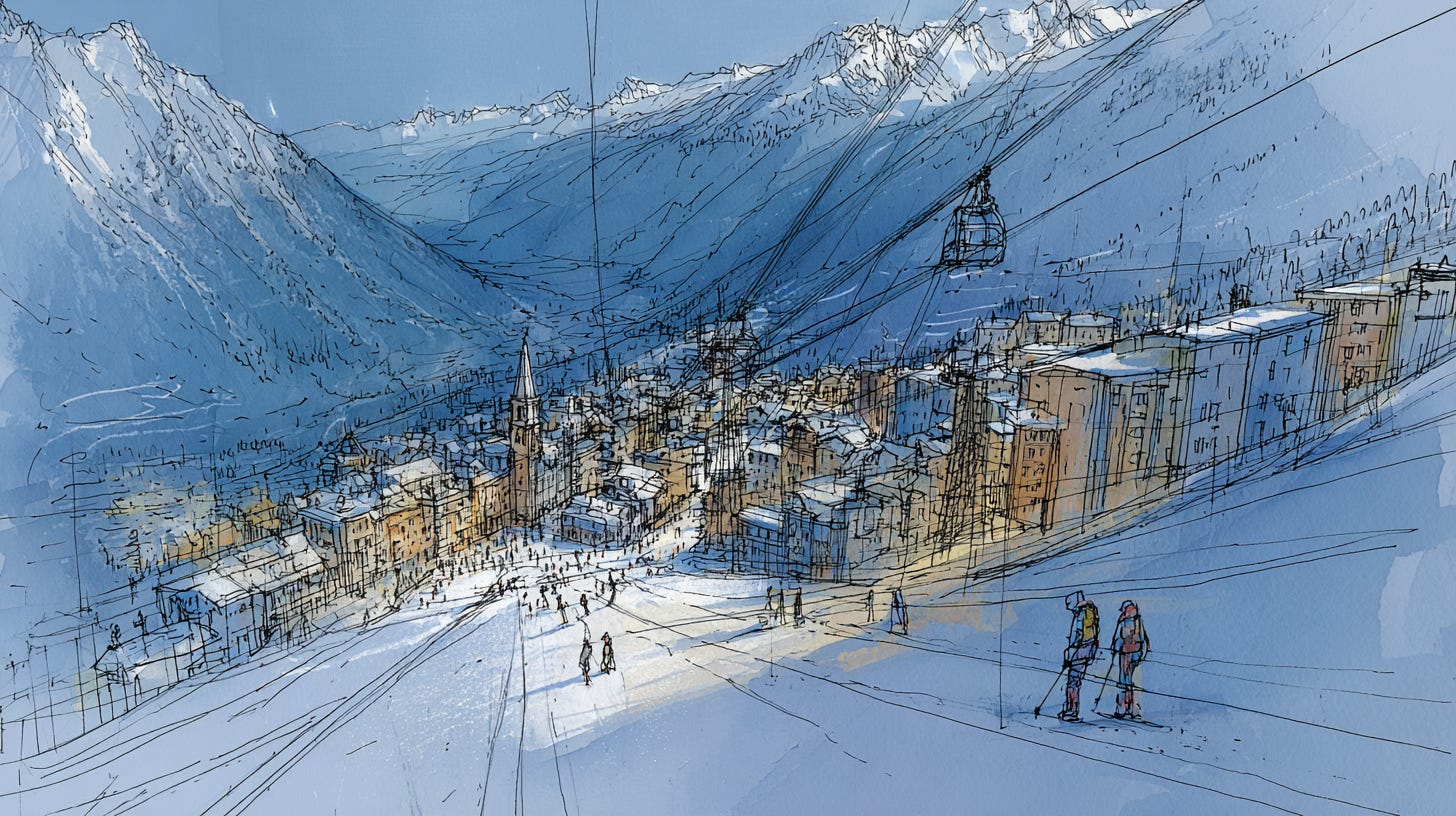
If the Olympic torch symbolized that spirit, the Promethean flame pulsed at night in Cortina, Livigno, and Milan, illuminating La Scala, the Duomo, the Naviglio Grande before filtering into the plazas and ancient streets beyond. By day, the snow-mantled Dolomites framed alpine villages nestled in valleys at the bottom of the slopes—themselves a reminder that civilization runs downhill.
I have not been so into the Olympics, in any season, in years. Perhaps it was the athletics, the stunning scenery, the NBC production value, the afterglow of Heated Rivalry.1 It might have been more personal: these were the first I had watched since snapping on ski boots again a few years ago, after a 17-year hiatus from the sport. The Games began only a couple weeks after I’d skied in Northern Japan’s Furano, so the memories were fresh and visceral: the scrape of skis against snow, the blast of alpine air against my face, the lactic burn in my legs.2
Recent Games have been harder to love, overshadowed by geopolitics and controversy. The Sochi Olympics, with their Potemkin ski resort, mirrored Russia’s Potemkin democracy only weeks before it seized Crimea. Pyeongchang marked the primetime debut of the now-ubiquitous drone show and the high noon of South Korea’s abortive Sunshine Policy towards the hermetic North. The 2022 Beijing Games were an about-face from the world-stunning 2008 Olympics, with much of the world shunning them after sixteen years of intensifying repression—from the Uyghurs to Hong Kong to “Zero-Covid.”
Beyond geopolitics, the Olympics came to seem inseparable from scandal: corruption at the IOC, doping among athletes, cities bankrupted by monument building and left with modern-day ruins. Others have used the Games to justify sweeping infrastructure projects, while swatting away environmental or displacement concerns. More recently, host cities have tried a different approach: building less and making better use of what already exists. London converted its Olympic Village into a mixed-use neighborhood. Paris showcased the city itself rather than expensive new monuments and will turn its athletes’ village into housing. Still they had their problems.
This is not to say that Milan-Cortina was pristine or painless. Critics protested the felling of hundreds of trees for a bobsled track that even the IOC discouraged. Residents of Milan’s once-working-class Porta Romana district resisted development amid fears of further gentrification. There were the inevitable absurdities: “Penisgate” in ski jumping and a shortage of condoms in the Olympic Village. Yet these controversies never became the story of the Games themselves. There was too much else going on—the athleticism was real, the arenas were, too. The Games unfolded across a living landscape, so the flaws felt like the messy frictions of a real city rather than the hollow theatrics of a rotting regime.
A prosperous city in a peaceful country, Milan showed the world a different face of the Olympics—one that showcased its man-made terrain as much as its natural beauty.
Milan is a living city in a working region, one connected to the alpine valleys where winter sport became a way of life. Civilization settled here more than 2,600 years ago and spread into the surrounding valleys that today host ski resorts. Milan may not inspire the same oohing and aahing as Venice, Florence, or Rome but as Italy’s fashion, financial, and industrial capital, it sings its own arias. It belongs to a landscape where winter is not an abstraction but a season to be mastered. From Milan’s streets the same civilization extends upward into the mountains.
The Games captured something I’ve always loved about winter life: the triumph over winter itself. If civilization accumulates in the valleys, modern technology carries it uphill.
Gondolas and chairlifts trundle along steel spines up manicured slopes carved from mountain faces, carrying humanity into a cultivated landscape of lodges and lift stations, restaurants and restrooms—islands of warmth and light in an otherwise hostile terrain. Here, the wilderness comes into view: snow-capped peaks in one direction, the backcountry in another, the sky above it all. We traverse this landscape of packed snow on composite strips of wood and metal and carbon fiber, enclosed by the pines or, if above the tree line, by the contours of those who have gone before. The magic of the mountain is maintained by man—everything else would by its nature kill us.
As the shadows grow long and the sun begins its sharp descent, we ski downhill. Down St. Anton’s slopes where Austrian shepherds still graze their sheep, into valleys where Furano’s meadows fill with lavender, into the streets of Crested Butte and Telluride where coal dust and gold dust once fell like snow.3 It is there, at day’s end, that one enjoys the immensely civilized custom of après ski, sipping schnapps by fireplaces in mountain lodges or around fire pits in Adirondack chairs.4 Afterwards, the spirit warmed, skiers walk kintsugi streets in awkward boots back to their lodgings before setting out again on sneakered feet for dinner.
There is urbanity here, clad in down-filled parkas and woolen mittens.
Perhaps that was what was most striking: the seemingly effortless athleticism against a backdrop of seemingly effortless urbanism. That excellence is, of course, not effortless. The athleticism reflects years of grueling training, the urbanism reflects centuries of accumulated building. Watching the Games as an urbanist on skis, I found myself drawn into an Olympics that made it all visible. At a moment when inspiration feels rare and mediocrity common, Milan-Cortina reminds us—in the extraordinary figures of its athletes and the basic urbanism of its streets—that winter can be mastered. Between these hills and valleys, excellence becomes part of the ordinary landscape. The ski trails carved into the mountains slope back to civilization, where tomorrow the gondolas will rise again, lifting us towards Olympus.
Sadly, there were no such miracles on ice after the men’s hockey final.
For more Japan content, see my recent writing on Tokyo’s human-scale urbanism and Japan’s legendary toilets.
I cite these examples because I’ve skied at them over the past few years.
Although St. Anton’s après seems less civilized at the infamous MooserWirt, where the “Final Countdown” blares from speakers in its ski-in/ski-out beer garden set up mid-slope.
This was a wonderful column! It really hit home. I was in Milan in June and absolutely loved it. I’m so glad I didn’t listen to all the people who told me I was crazy to spend four nights and three days there, that one full day was enough. No way! I’d go back tomorrow!
NBC should have covered the games on their sports channels if they have them. The athleticism, grace and pageantry were probably beautiful to watch on one level, but we seem to conflate the importance of college and professional sports with other things that REALLY ARE MORE IMPORTANT. I hope at least that there were public service announcements about the importance of exercise and physical fitness.