


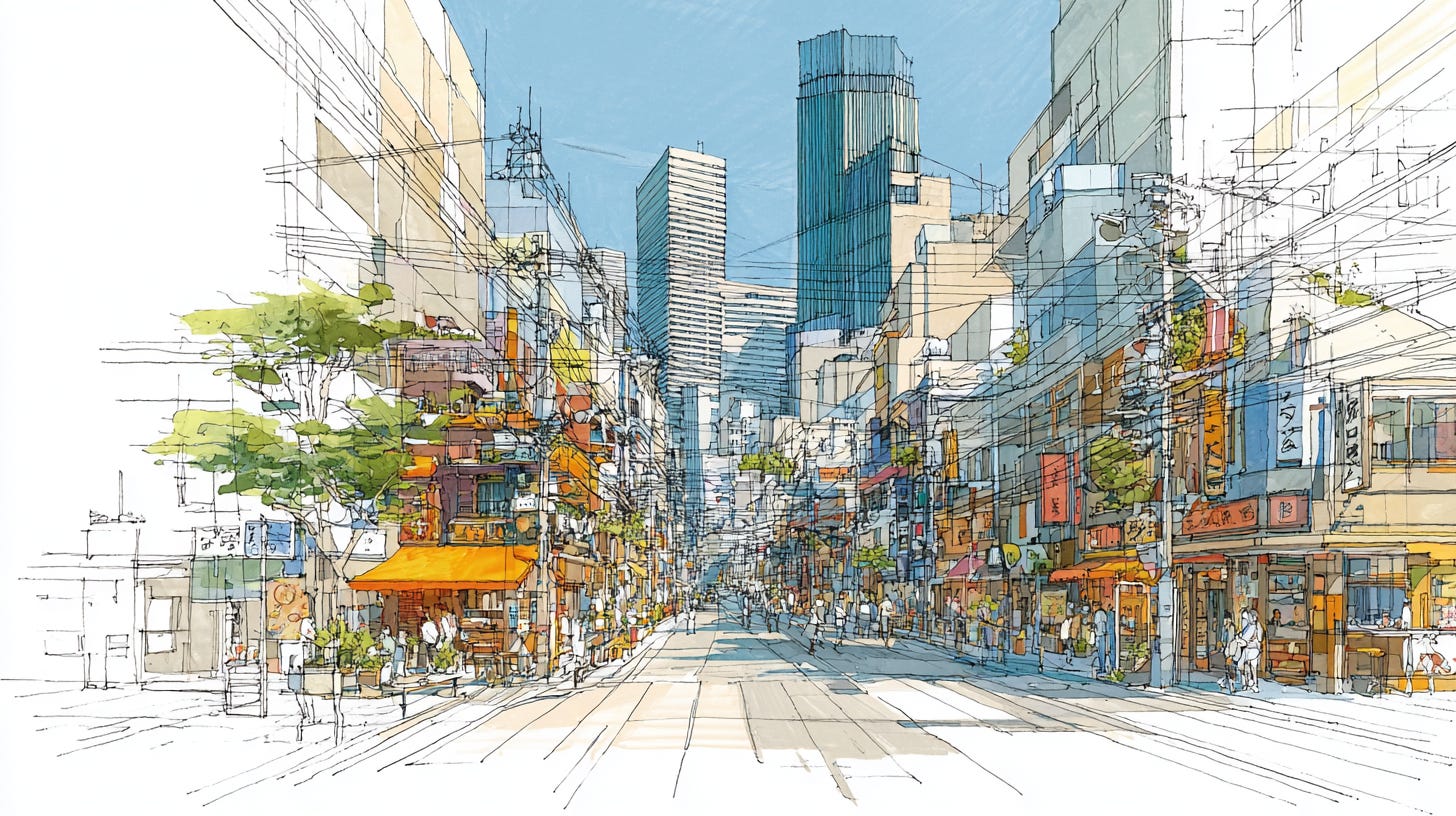
Tokyo greets the visitor in full force. Its scale is almost incomprehensible: a wall of buildings, a wash of light, a mass of bodies, the babel of ten million voices. And it is all in motion. From the whoosh of the Shinkansen to the unchoreographed ballet of thousands crossing at Shibuya, Tokyo is a city where people are always going somewhere—walking, wandering, but almost never lingering. Last month, I was back for the first time in fifteen years. Once I reoriented, this “megacity” revealed a different face. Off the main corridors, the scale suddenly contracts: the streets narrow, the buildings shrink, and the crowds dissolve into smaller streams of people. Beneath the incomprehensible whole lies a city that feels small-scale, intimate, and incredibly vibrant in a way few Western cities achieve.
And yet this is a city of 37 million people.
Tokyo’s ability to fit so many people into one place isn’t the result of meticulous, top-down planning but of what Jorge Almazán and Joe McReynolds call “emergence,” the “spontaneous creation of order and functionality from the bottom up.” In their book Emergent Tokyo: Designing the Spontaneous City, Almazán and McReynolds identify the five “ingredients” of Tokyo’s emergent urban environment: yokochō alleyways, zakkyo stacked buildings, undertrack infill development, flowing ankyo streets, and dense low-rise, car-free neighborhoods.1 Once you know what to look for, these features are everywhere. Because they feel so natural, it’s easy to miss how they carry the weight of millions—and keep the city from being crushed by it.
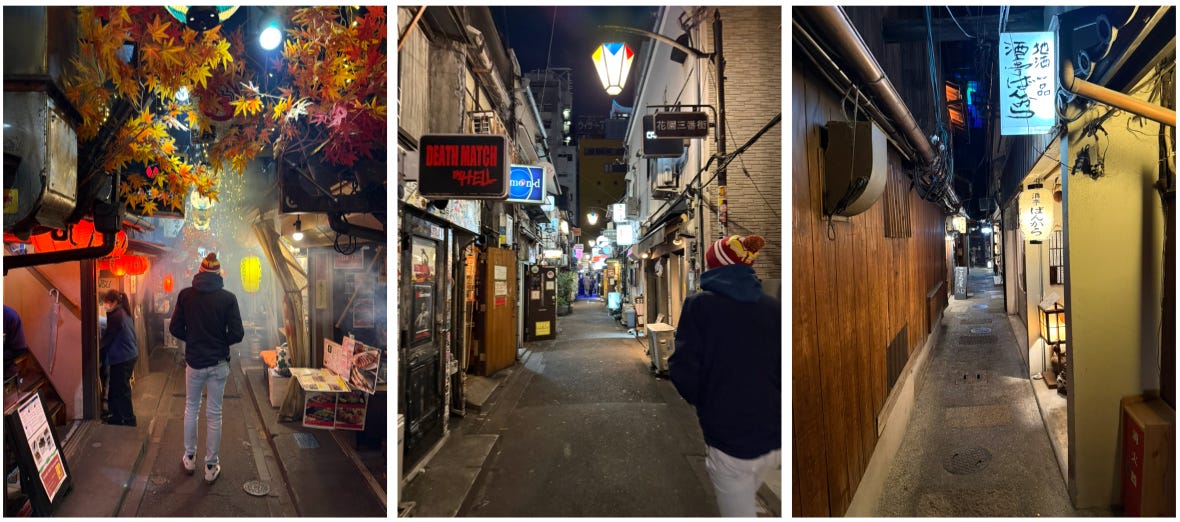
Walking is my preferred way to explore a city: it’s the surest path to discovery and delight. Hidden near commercial districts and railway stations, yokochō (literally “side streets”) are warrens of narrow alleyways along which tiny bars and restaurants cluster. In these warrens, establishments serve only five to ten customers on footprints often less than 15 square meters. This smallness is the point: it lowers overhead, encourages idiosyncrasy, and helps small operators survive.
The experience of the yokochō can be intimidating: the spaces are so intimate you feel as if you are intruding on a secret. Golden Gai, once a post-war black market, now packs 250 bars into an area smaller than a soccer field. There, we found a six-seat bar where the owner hand-cut ice over cocktails and conversation. Earlier that evening, we had the worst meal of our entire 10-day trip at a yakitori stall in Omoide Yokochō—which translates as “Memory Lane” but which we’ll more fondly remember by its other moniker, “Piss Alley.” Meanwhile, we enjoyed one of the best meals of our trip on a hidden yokochō in Kyoto. The granularity of these alleyways creates a vibrant ecosystem impossible in wide-block, large floor-plate developments.
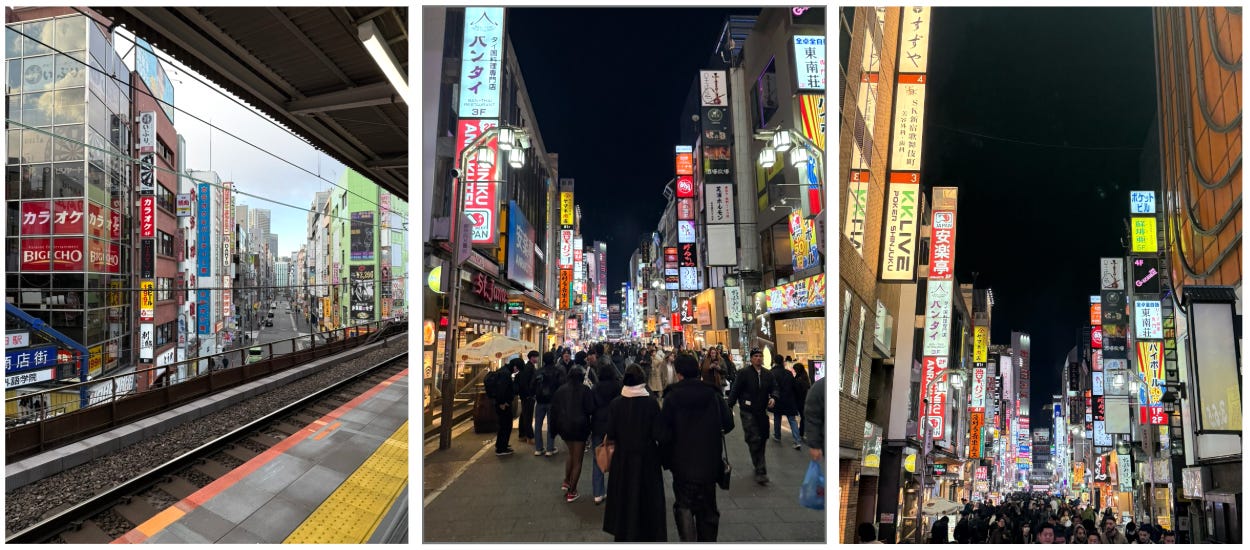
If Golden Gai is something of an oasis amid the high-rises of Shinjuku, the ward is also famous for another form of commercial density: the zakkyo, which somewhat beautifully translates to “coexisting miscellany.” The slender zakkyo buildings, typically 5 to 8 stories on narrow lots, take the logic of Golden Gai and make it vertical. They concentrate an astonishing diversity of offerings: an izakaya on the ground floor, a pachinko parlor on the second, a karaoke box above that—all advertised in bright neon signs that draw pedestrians upward. They are designed to be permeable: zakkyo buildings often feature “active edges” with stairwells and elevators open directly to the street. By shifting pedestrian traffic from the curb into vertical space, Tokyo multiplies the possibilities of every square inch.
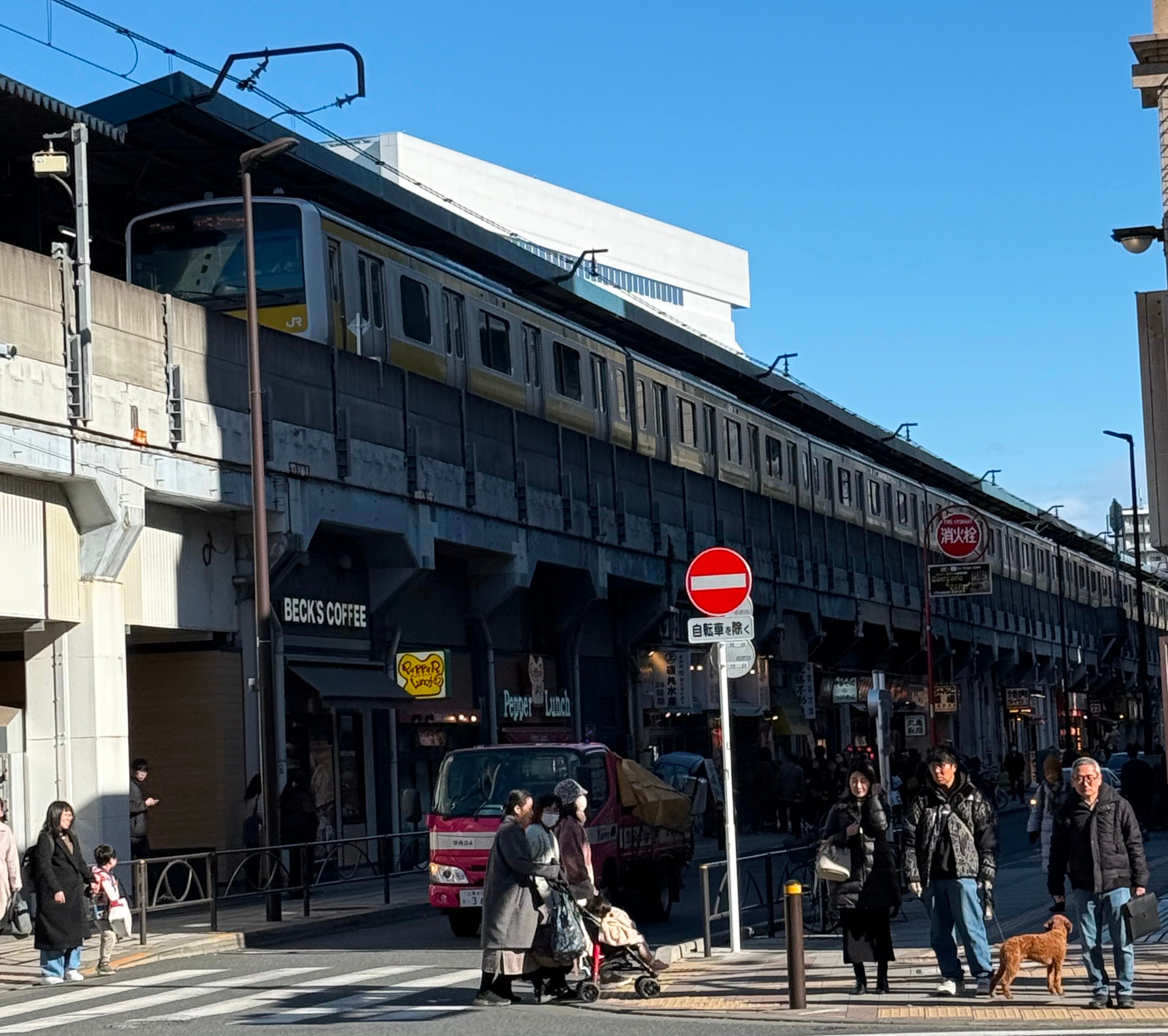
This efficiency extends to spaces other cities consider unusable: the dead zones beneath elevated railroads and highways. In the US, “under the tracks” is usually a warning. In Tokyo, it’s an opportunity: cafés, restaurants, and shops nestle beneath the concrete ribs of rail lines and expressways, turning what Jane Jacobs called “border vacuums” into active corridors. At Ryōgoku Station, an undertrack café provided a welcome respite from the cold while we waited to enter the nearby Kokugikan Arena for the sumo championship. Even highways are integrated this way: along the Ginza Corridor of the Tokyo Expressway, rental fees from shops below help finance the road above. By treating these infrastructural leftovers as opportunities, Tokyo creates connectivity where other cities destroy it.
What’s striking, however, is that this vast city is not an endless sea of towers. Evident from the observation decks of Tokyo Skytree and Tokyo Tower, the city is largely low-to-mid rise, punctuated by clusters of skyscrapers. Perhaps most surprising is how quickly building height diminishes around the skyscrapers: indeed, much of Central Tokyo is characterized by small apartments and narrow 3-to-5-story buildings, while even some of the center and most of the suburban wards beyond the Yamanote Line are dominated by dense low-rise neighborhoods of one-to-two-story homes.


These neighborhoods have very small lots, high lot coverage, and narrow, ancient alleys and laneways called roji. Occasionally, a winding, pedestrian-only street betrays its history as an ankyo—a “dark canal” paved over in the rush to modernize. Tokyo has an average density of 38,000 per square mile, yet these neighborhoods feel unexpectedly calm. This is because cars are largely absent. Most of the roji predate modern width requirements, making driving impractical and sidewalks unnecessary. In their absence, the street becomes a shared, safe space for walking and community. These neighborhoods are often ringed by arterial roads where taller buildings cluster, but commerce is allowed almost everywhere. Single-family homes can host small businesses, and most areas are anchored by shōtengai, pedestrian shopping promenades that serve as neighborhood arteries. These areas feel like villages, yet they support a density sufficient to sustain world-class public transit.
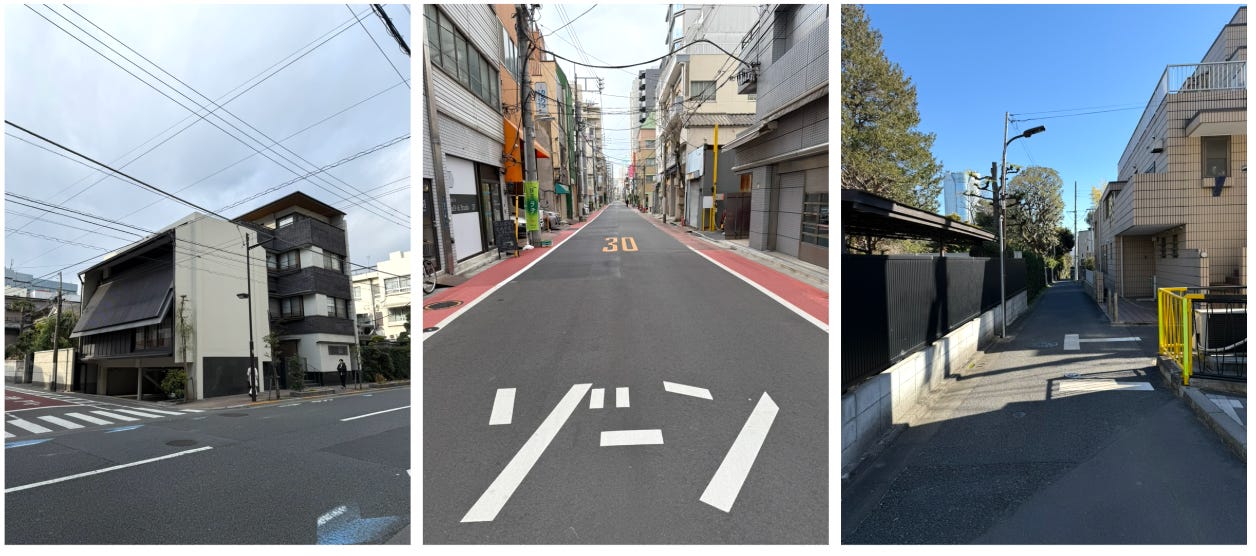
Today’s village feel is an echo of an invisible past. Almazán and McReynolds argue that although few buildings from the pre-Meiji Edo period survive—the average age of a home in Tokyo’s low-rise neighborhoods is just 30 years—“Edo’s heritage is visible all across Tokyo, embodied not by individual works of architecture but rather by the city’s underlying physical and social configuration.” The small parcels of land and the human-scale street grid are the bones of the seventeenth-century castle town, persisting through fire, war, booms, and busts.
After the firebombing of World War II, much of Tokyo was rebuilt along the preexisting property lines. Where American planners might have seen an opportunity for wholesale clearance and rationalized grids, Tokyo’s property owners rebuilt on their own parcels, preserving the historic, organic street network. In many cases, infrastructure was added through a system of land readjustment, in which owners pooled land for streets and transit improvements and then received smaller, more valuable plots in return—a process that allowed the city to modernize without the mass dispossession that defined American urban renewal.2
That continuity allowed Tokyo to modernize without erasing its underlying structure, preserving the connective, human-scale fabric that still defines the city today—and helping keep large parts of the city within reach of ordinary residents.
It’s not a perfect place. There are few parks, green spaces, and plazas—and when there are, they are likely to be bereft of benches. Greenery emerges in bursts of potted plants, small gardens, and shrines tucked into the interstitial spaces of the city’s neighborhoods. Outdoor dining and drinking are almost unheard of. In the run-up to the 1964 Olympics, Japan engaged in a Robert Moses-style spree of urban highway building, while the city’s experiments with “towers in the park” modernism are as soul-crushing as they are anywhere.3 Meanwhile, the prevailing building trend is what Almazán and McReynolds call “corporate-led urbanism,” typified by megadevelopments like Roppongi Hills and Azabudai Hills. These “towers in the mall” are essentially closed systems, designed to exclude the city rather than extend it, breaking up the circulatory network and turning their backs on the traditional Tokyo street.4
But the traditional Tokyo street itself follows a different logic.
As Almazán and McReynolds write, “the street is first and foremost treated as a space to move, not to linger.” This is a relatively recent shift. Edo-era streets were places for both commerce and community, but postwar policy choices—restrictions on street stalls, modernist traffic separation, and restrictive police management—gradually pushed activity indoors. Even the few benches that exist in Tokyo’s public spaces are often designed to discourage long stays. The street here is a place to move through, not to settle into. Tokyo is, in that sense, a network of edges built for dispersion rather than nodes meant for lingering. A city like Lisbon, by contrast, is a network of nodes. When I visited last year, its streets and plazas offered a nearly continuous public–private interface: places to sit, sip, and watch the world go by.
In Tokyo, the people are in motion, and the world is a blur.
Tokyo is a city optimized for circulation. This doesn’t make it a bad place, just a different one. Because temperatures were below freezing during our visit, we weren’t looking for al fresco dining—and we didn’t need to. If the European plaza is an extension of urban living space, Tokyo’s street network is a series of hallways leading to a much larger indoor realm. That is where the lingering happens: in the six-seat bars, the third-floor cafés, and the basement izakayas. While the streets of Europe provide breathtaking views, Tokyo’s public realm provides a network of inner discovery. It is not a city of vistas, but a city of doorways.
Can any of this emergent serendipity translate to Western cities? We see flashes of it at times: a Japanese-inspired bar in an Austin alley, or the hidden murals and establishments of Freeman Alley in Manhattan. But these remain exceptions. Our highways still carve border vacuums instead of supporting the surrounding community, our neighborhoods still separate homes from commerce instead of layering them together. Parking minimums, single-use zoning, and rigid life-safety codes make the kind of small-scale diversity seen in Tokyo difficult to reproduce.
The deeper lesson is not aesthetic but structural: American cities are unlikely to look like Tokyo, but they could aspire to be more connected like it. A city of millions only feels livable when its parts are closely stitched together—when streets, buildings, and transit form a continuous network rather than a series of isolated destinations. Tokyo works not because it is orderly or monumental or even beautiful, but because almost everything connects. Its streets make space for all the “coexisting miscellany” of urban life to move about freely—and that connection might be the most important ingredient of all.
Tokyo works because of its “coexisting miscellany.” My work at City of Yes is dedicated to understanding how we can bring that kind of serendipity to our own cities. To keep this work sustainable, I am moving to a more frequent paywall model starting this month. I’ll still publish free essays, but more of my essays will be reserved for paid members. If you value this work, consider joining the nearly 100 paid members who make it possible. Thank you!
We didn’t knowingly encounter any ankyo streets during our trip, so I have not paid them as much attention here as Emergent Tokyo does.
The Tokyo government has tried to incentivize the reconstruction of low-rise wooden buildings to modern safety standards, but its own policies often get in the way. Strict setback requirements (setto-bakku) mean that rebuilding a house often requires ceding precious square footage to the street, while high inheritance taxes force the fragmentation of family lots. The result is that small, unsafe buildings are preserved along with their historic scale.
Unlike Western cities, these were largely built on reclaimed land and decommissioned industrial sites rather than “blighted” neighborhoods.
While these corporate developments may feel sterile, they are designed to be earthquake resilient and self-sufficient, with their own gas-powered plants and stockpiles to feed thousands of stranded commuters during a disaster.
What blows me away is the transit coverage. Having the ability to connect 37 million people by transit is an amazing thing. It is an incredible achievement. The city seems similar to NYC to me, just muuuch larger (and with unique features, as you describe). I didn't buy Emergent Tokyo's hostility to new development though. There's room there for everything, that is what has worked so far.
Great post, as usual. Having visited Tokyo and Niigata, Japan, what makes these cities vibrant and able to handle the quantity of the residents and visitors is the high quality and reliability of Public Transportation. The Japanese government has invested in public transportation so it is safe, reliable, resilient to earthquakes and affordable. Public Transportation across Japan runs 24 / 7 /365 every 20 minutes, so people know it is a better option than a car most of the time.
Sometimes the solution is that simple.