



Hi readers! I recently appeared on the Solving America’s Problems podcast with hosts Jerremy Alexander Newsome and Dave Conley. We had a fun conversation about Austin, zoning reform, SROs, and more. I hope you’ll give it a listen here.
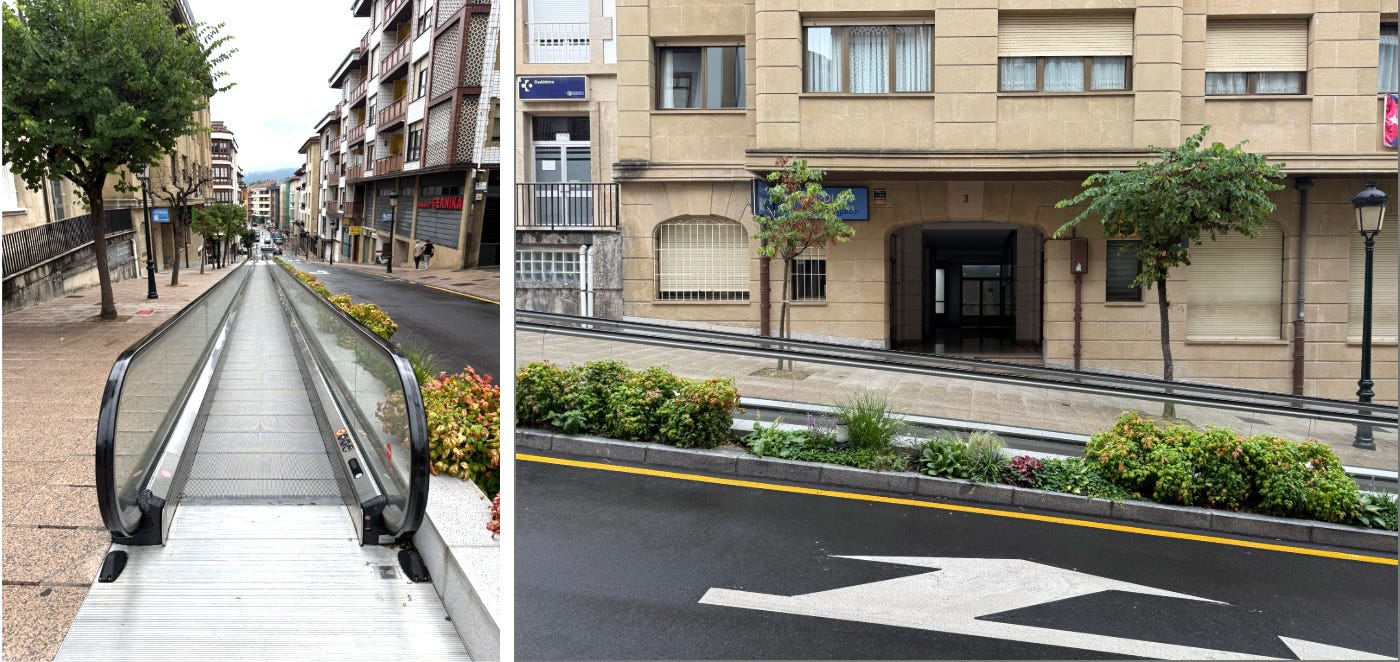
Among the horrors inflicted on Spain during Francisco Franco’s rise to power, perhaps none was more vividly memorialized than the bombing of the Basque city of Guernica in 1937. The destruction of the city was famously depicted by Pablo Picasso in the epic, eponymous painting that now hangs in the Reina Sofía Museum in Madrid. Today, this prosperous town of 17,000 has been rebuilt. Aside from a memorial in the town square and a life-size mosaic of Picasso’s painting, you would hardly know what horrors befell it. Yet while visiting Guernica recently, I found myself more interested in the strange sight across the street from the mosaic. Our tour guide found it muy curioso that I was photographing a moving walkway built into the steep sidewalk instead. As I later learned, this novel piece of infrastructure is one way that Spanish cities like Guernica are preparing for the future. In rapidly aging Spain, where being over the hill is a daily challenge for its senior population, cities are pursuing vertical mobility solutions to help residents get over the hills—literally.
Aging in place, properly understood, is not merely about remaining in a particular dwelling but about retaining the ability to live independently in one’s neighborhood and community. It’s a mobility problem as much as a housing problem.
While the mountainous terrain of the Basque Country provides dramatic vistas and gorgeous beaches, it makes the urban landscape a bit of a hike, especially for seniors and others with mobility challenges. The moving walkway in Guernica is along one of the steepest streets in the centro, and the municipal health center is located at its highest point, creating accessibility problems for those most in need of its services. The first phase of the project began last year and included a 48-meter moving walkway that climbs six meters at a gentle incline and glides along at 0.5 meters per second. According to the mayor, this investment is worth it: “We are not just talking about accessibility. This ramp reflects the City Council’s commitment to a more welcoming and modern city.”
But this commitment comes at a steep price: the mechanical ramp cost the municipality more than a million euros.
As societies around the world age rapidly, governments are struggling with how to help seniors age in place. This is especially true in Spain, which has one of the oldest populations in Europe. Those over 65 make up 21% of the total population, and even more in the four regions I visited this summer: the Basque Country (24.5%), Cantabria (24.9%), Asturias (28.7%), and Galicia (27.1%). That longevity is good news for the Spanish, but it leaves their governments with the harder question of how to pay for the housing, healthcare, and mobility needs of their aging seniors.
In Spain, northern governments are responding by making major investments in vertical mobility infrastructure. The Basque city of Bilbao has built eighty-four elevators, escalators, and mechanical ramps to help pedestrians get from low elevation neighborhoods to higher elevation ones. In a city whose suburbs creep up the slopes of the surrounding mountains, these interventions help pedestrians avoid taking long detours or climbing huge staircases, while they make some areas accessible that would otherwise only be reachable with grappling hooks. Most of these elevators are free to use, and they operate twenty-four hours a day. As part of its universal accessibility plan, Bilbao studies each neighborhood before making an intervention, analyzing four criteria: the catchment area (i.e., a realistic walking radius), the size of the population served, connectivity to transit, and pedestrian volume. The city also references an aging index when deciding which neighborhoods to prioritize.
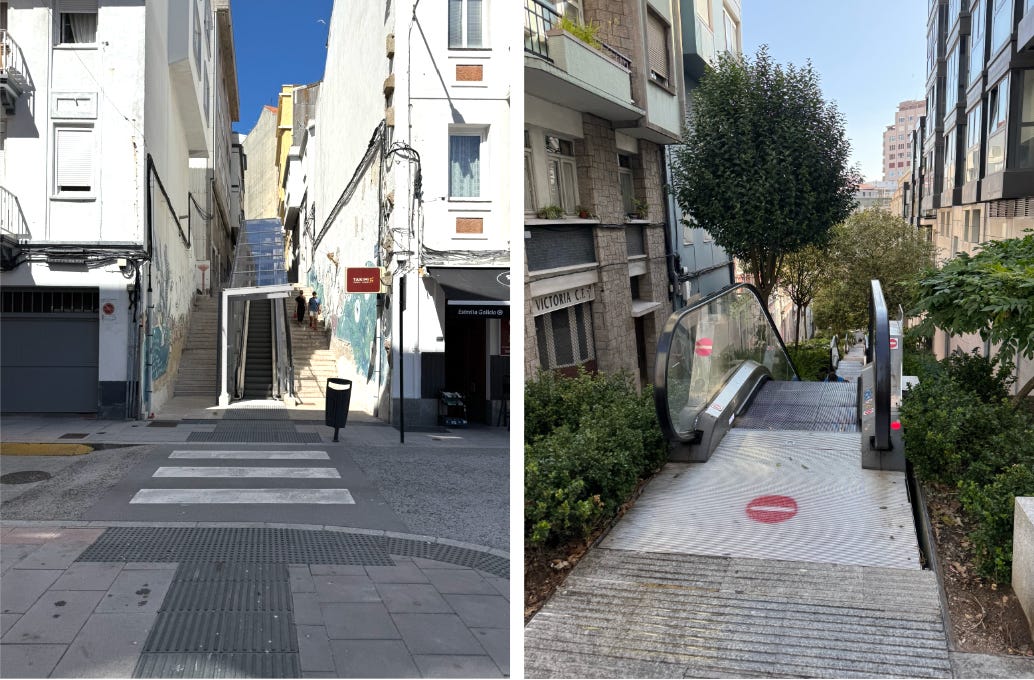
In Galicia, the city of A Coruña has a Vertical Mobility Plan to improve pedestrian accessibility, especially for the elderly, in neighborhoods with the steepest inclines. In the Monte Alto neighborhood, one of the densest and most challenging topographically, a newly completed covered escalator was accompanied by improvements to the surrounding streetscape (stairscape?), including new lighting, safety railings, benches, and aesthetic enhancements. As one Galician paper described it, the project was needed to guarantee “universal access”; neighbors saw it as meeting “the real needs of its residents.”
These projects expand mobility options for all pedestrians, not only for the elderly, including those with disabilities and families with young children. Are they worth it?
The upgrades are costly, starting in the low hundreds of thousands and running into millions of euros per project depending on the type of improvement and scope. Outdoor escalators command a price premium of fifty to one hundred percent over indoor models because they require weather-resistant upgrades such as waterproof electronics, anti-corrosion materials, and drainage systems. Meanwhile, industry data suggest elevators break down four times per year on average under normal conditions. Exposure to the elements increases the risk of failure, while vandalism from graffiti or equipment damage causes unplanned repair costs.
In A Coruña, in particular, maintenance issues have been an ongoing problem and source of complaints from the community. With its temperate coastal climate, the city’s escalators are exposed to, and damaged by, moisture from storms and the accumulation of debris; even repairs require good weather. Newer escalators are built with canopies to mitigate the effects of weather exposure, but maintenance issues persist.
Yet the cost of doing nothing will also grow, including in the United States, which has its own mobility challenges. More than four million Americans turn 65 every year, and the entire Baby Boomer generation will be 65 or older by 2030. Those over 65 already make up 18 percent of the population, and will represent 23 percent by 2050—some 82 million people. Meanwhile, according to the AARP, 78 percent of seniors want to stay in their current home as they age.
This was certainly true of my grandmother. My dad’s mom lived in the house she’d called home for sixty years, until the day she died aged 89. She had decades-long friendships with next-door neighbors, which during Covid became a social lifeline as they drank boxed wine in each other’s backyards during near-daily happy hours. My grandmother didn’t want to live amongst strangers with no control over her daily life; she wanted access to friends, her favorite stores, church, and doctors—on her terms. She was also able to drive until the end of her life, which is why any of that was possible. In the absence of other mobility options, the house she loved could easily have become a prison.
That’s the value against which the costs of mobility infrastructure should be measured. A million-euro escalator sounds expensive, but the alternatives are not free, either. Elderly immobility may mean greater dependence on caregivers, paratransit providers, senior services, and healthcare, often at public expense. Then there is the social cost of so many seniors who might otherwise be stuck at home. The type of infrastructure a society builds is, ultimately, a reflection of the kind of life it values.
Making mobility infrastructure practical is another matter.
Even Spain has figured out only part of the problem. Its compact, walkable cities make daily life possible without a car, and cities like Bilbao and A Coruña are certainly making the public realm more accessible. But more than five million Spaniards live in buildings of three or more stories without elevators, including more than one million people over age 60, a deficit owing in large part to Francoist urban policy. This leaves some residents with an accessibility paradox: the neighborhood beyond their building may be easier to navigate than the building itself.
Still, despite this, Spain has 23 elevators per thousand residents, versus only 3.1 in the United States. Where buildings have elevators in America, the streets outside often have no sidewalks—or there’s nothing to walk to, anyway. Indeed, the Bureau of Transportation Statistics estimated that about one-third of Americans live in a community with no sidewalks. Even in urban centers, the numbers are staggering: 40% of streets in Denver are missing sidewalks, Dallas is missing more than 2,000 miles’ worth, while Austin’s deficit is about 700 miles.
While many cities are working to correct this problem, for the majority of American seniors who live in the suburbs, the problem isn’t hills but distance: horizontal mobility is almost entirely dependent on cars. This may be fine for those who are capable of driving, but as Kea Wilson shares in a moving essay about helping her father deal with end-of-life care, once a sick or elderly person can no longer drive, someone else has to fill the gap. If private care is too expensive and public assistance unavailable, that burden often falls on family members, as it did for Wilson herself. Whoever ends up playing chauffeur, senior mobility becomes contingent on someone else’s availability. Wilson describes canceled taxis and Ubers, limited paratransit windows, nonexistent public transit, and a grocery store she couldn’t safely reach on foot along a high-speed arterial. Living in a gated suburban community is certainly nice when you’re healthy, but the bargain changes once you need regular medical care and live nowhere close to hospitals or treatment centers, a fact that remains true even if those caregivers come to you.
Neither country has finished the job. Spain starts from a far better place, but the United States isn’t dealing with a hill: the problem is a landscape never designed for movement without a car. For the vast majority of America’s seniors who want to age in place, the answer isn’t as straightforward as building an escalator. A home cannot sustain independence if its resident cannot get out of it, or if, once outside, there is nowhere they can safely go. We should celebrate that more people than ever are living to be over the hill. But if mobility is what connects home to community, we have a long way to climb to make aging in place truly possible.
City of Yes is a reader-supported publication. If you find this work valuable, please consider becoming a paid subscriber. Thank you for your support!
The United States is woefully behind in all forms of transportation (local, regional and national) compared to nations like Spain and most of Europe and Asia. Our trains are pathetic, our urban mass transit is laughable except in a very few cities and we have developed vast tracts of urban sprawl that depend solely on the automobile.
With an aging population, we are way behind the curve in providing mobility. We have a lot to learn and a lot to do.
Great topic and enjoyed reading about Spain, and visiting Spanish towns and cities appeals to me.
What this piece left out are relevant characteristics for aging-in-place. In the US, aging-in-place is characterized by nuclear families moving into large homesteads in car-dependent sprawl. As children leave the family house, a homestead appropriate for a large family is only occupied and maintained by one or two aging people. It has an expense problem, which NIMBYs try to both ways, depending on their purposes: "how can a poor aging person afford the property taxes on my home?" while arguing against downsizing because "I already own the home, so it doesn't cost much to live here."
Boardinghouses can partly solve the mobility problem of aging-in-place. Many boarding houses in the US were set up by elderly ladies as self-care plans for their dotage, with boarders providing income and companionship, and perhaps even ran some errands. Aging-in-place in the US is more fundamentally a living-alone problem than a mobility problem. I don't know the particulars of Spain, so I don't have a basis of comparison.