


Today’s essay is free for everyone, but about half of City of Yes essays are reserved for paid subscribers only. The best way to support this work is to upgrade your subscription.
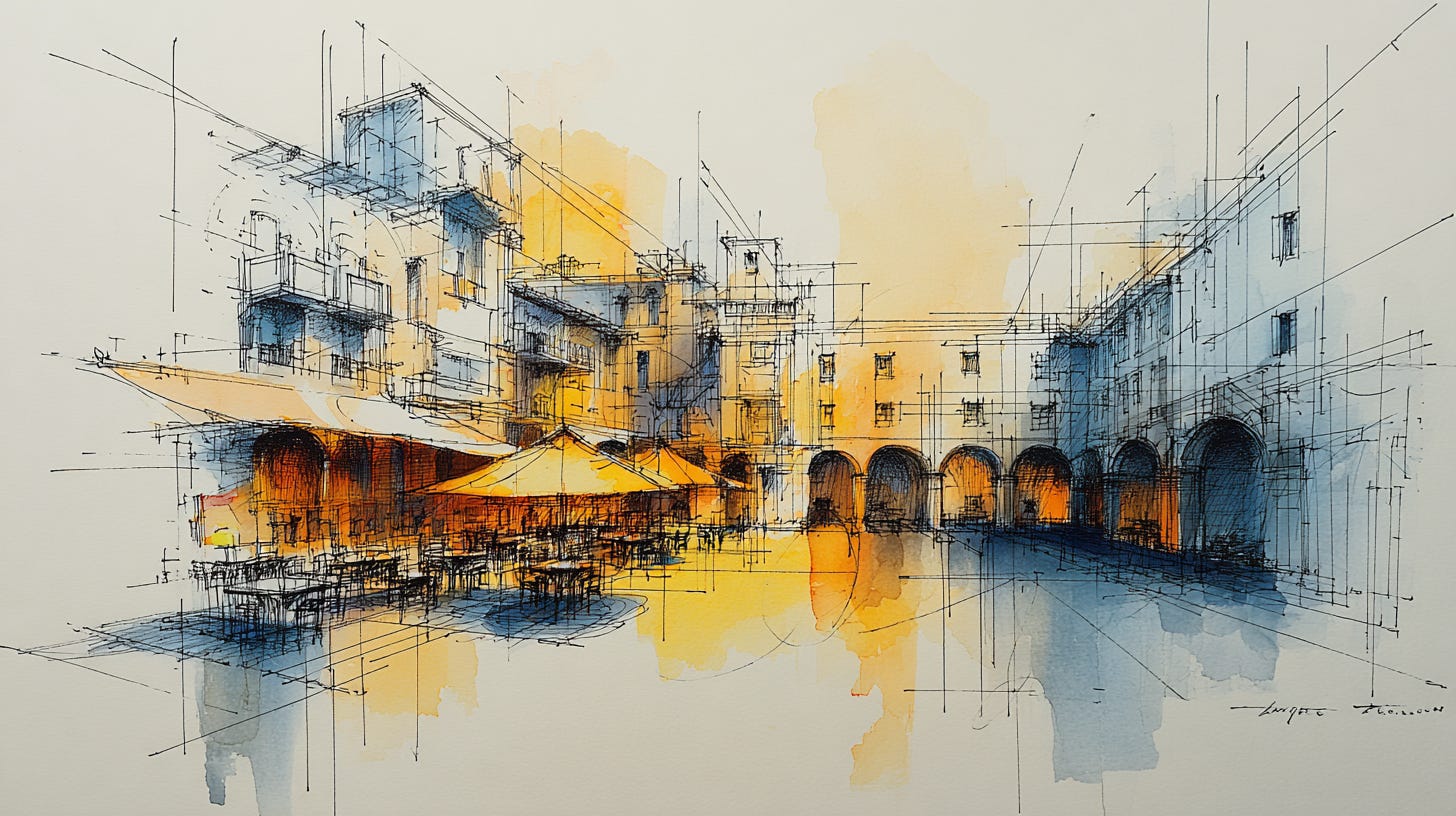
The crooked streets of San Sebastián’s Old Town lead the weary traveler to refuge from the summer sun. Through narrow pedestrian alleys lined with pintxo bars and bakeries, the space suddenly opens into an expanse of light at the Plaza de la Constitución. Beneath its neoclassical arcades, cafés spill into the plaza, their umbrellaed tables beckoning passersby to take a seat and sip a kalimotxo or glass of tinto, to imbibe the murmur of the city as the Atlantic breeze wisps through its honey-colored buildings and tiled streets. “La Consti” is the quintessential European plaza, the distilled ideal of walkable urban life.
At 9am, the entire plaza is a parking lot.
Late at night, after the last stragglers stumble home, the plaza empties. Chairs are stacked, umbrellas tied, and everything is pushed under the arcades. By morning, it fills again with trucks and delivery vans bringing in the food, booze, and fresh linens that make the square come alive as a gathering place later in the day. Before the first coffee orders are placed, they’re gone, and the square returns to its familiar form. The Plaza de la Constitución is an aperture in Old Town’s medieval grid—and a window into a basic fact of urban life: the café on the piazza depends on a network of vendors, warehouses, and distribution systems that operate from somewhere else.
Every vision of the good city edits out the unglamorous aspects that make it possible. It’s easy to imagine the city square, the walkable street, the human-scaled neighborhood—and to forget that even the most connected 15-minute-city is but one node in a much larger human network. Modern life depends on infrastructure cities cannot function without.
Trains need rail yards, buses need depots, and delivery trucks need parking lots. Before goods reach our stoops or our favorite shops, they pass through a network of ports, airports, loading docks, warehouses, and cold storage. New homes require lumber yards, steel mills, and concrete plants. The fountain in the park and the flush in our toilet would not be possible without sewage treatment plants and pumping stations. Waste collects in recycling centers and materials recovery facilities instead of on city streets. The knowledge economy is not “in the cloud” but grounded in a network of electrical substations, fiber-optic vaults, and data centers.
These systems are often unsightly, disruptive, and obnoxious. Understandably, nobody wants them in their backyards—and yet we have to put them all somewhere.
That tension shows up in our planning decisions, as well. Last month at Austin’s Zoning & Platting Commission, we had a first-of-its-kind case. An autonomous vehicle (AV) company was seeking to rezone a lot to allow for fleet maintenance and storage uses: basically a place to park and service their cars. The land in question was in an existing industrial/office park adjacent to Dell’s headquarters, nearly twelve miles north of downtown, along a major corridor a short drive from the interstate highway. During the hearing, commissioners disagreed about allowing an intensive auto-centric use in this area, which is now surrounded by single-family homes and apartment buildings on three sides.
There’s an argument that this site could one day become housing—which Austin still needs—but a city can’t only be about housing. Every industrial site converted to homes is one fewer place for the unglamorous uses that make the rest of the city possible. Austin’s growth has already swallowed much of the industrial land that once absorbed uses like this. AVs like Waymos are already driving on Austin’s streets and part of the central city’s mobility system, and they operate under state law that limits what the city can do to regulate them. The question was never whether they need somewhere to go. It was where.
Put them downtown—where the ill-fated Cruise stationed its AV fleet—and it creates a permanent parking lot on valuable land that could be put to better use. Push them to the periphery, and it increases travel distances and costs, while paving over greenfield lots. Refuse them, and they don’t disappear—they just show up somewhere worse. If not on an existing industrial lot along a central traffic corridor, where else should they go?
City staff recommended approval, and we voted 6-4 to grant the rezoning.
The AV depot is just a more visible version of an old question: how we allocate space among uses that we treat as incompatible but which are, in fact, necessary for the city to function at all. The central question—where does this go?—is a citywide one. It can only be answered at the level of the whole system: how much space do we need for housing, for mobility, for logistics, for the invisible infrastructure that makes everything else possible?
We used to have better ways to answer.
In centuries past, cities laid out street grids, reserved rights of way, auctioned off lots, and largely let private actors sort out the rest. Unglamorous uses found their places alongside everything else—sometimes too close. “Incompatibility” and “zoning” hadn’t yet entered the planning lexicon, and so the warehouse, the rail yard, the slaughterhouse, and the tenement weren’t seen as problems to be solved by land use rules. Still, they generated real externalities: smoke, noise, the smell of rendering plants and tanneries, sanitation hazards that spread disease through densely packed neighborhoods. Industrialization and mass immigration intensified these conflicts at a scale cities hadn’t faced before. Cities turned to planning to manage it.
Early zoning attempted to manage the externalities of urban proximity: separating noxious industrial uses from residential neighborhoods made sense. But the same instrument proved useful for other purposes. New York’s 1916 zoning resolution was partly a response to garment factories encroaching on Fifth Avenue’s retail palaces—and partly an attempt to keep the immigrant workers who worked those factories out of more genteel neighborhoods. The jump from incompatible uses to incompatible people happened almost immediately, and soon zoning was being used to separate apartments from detached single-family homes, and detached single-family homes from everything else. Zoning was, from the beginning, as much about exclusion as about order. Once that logic took hold, it proved hard to reverse.
What began as broad zones gradually became finer-grained, and then finer still, until the zone dissolved almost entirely into the individual parcel. Every use, every building, every proposed change became its own negotiation. City-wide trade-offs don’t get made—they get deferred, parcel by parcel, until they reappear as crises: a housing shortage in too many places, a lack of space for infrastructure in others.
Much of what we now call “planning” serves to protect what’s already there today, not to plan for what the city might need tomorrow. The result is a system that can’t answer the question it keeps generating: where does it go? If the answer is “nowhere,” the needs don’t disappear—they scatter, reappearing in places less suited to them, or not at all. “Out of sight, out of mind” is not a planning philosophy.
The system we have is largely what people asked for—and it has conscripted planners into enforcing it. This is the “sanctuary suburb” mindset, a desire to capture the benefits of urban life without any of its costs, to see only one version of the city and keep hidden the parts that make it actually work—or to push those parts somewhere far enough away that they become someone else’s problem. Today’s planners are often the ones tasked with solving it, operating within a system that isn’t built to answer the question in the first place. Instead of working at the scale of the city to plan where the next generation of infrastructure goes, they are instead adjudicating the setbacks needed to make a triplex fit on a single-family lot. That’s not planning. It’s a waste of the time and talent cities desperately need directed elsewhere.
In Spain, the sun also rises, and once again the trucks will rumble into Plaza de la Constitución. Laundrymen will unload clean linens, fishmongers will bring out the morning’s catch of anchovies, and grease trap vans will pump out yesterday’s rancid oil. The parking lot of vans and trucks will clear out in time for the waiters to arrive, stubbing out cigarettes as they cinch aprons around their waists. Chairs and tables will roll out, umbrellas will unfurl, espresso and Aperol will flow across the plaza. La Consti comes back to life as the trucks and vans return to their corners of the city—out of sight of the plaza, in places nobody cares to look.
That part of the city may be unglamorous, but the glamour of the plaza would be impossible without it.
Independent writing can be unglamorous work, but it depends on readers who choose to sustain it. If you find this work valuable, consider becoming a paid subscriber to City of Yes.
You make some excellent points here. Cities depend on the LULUs—locally undesirable land uses. Those have to go somewhere!
Great points