


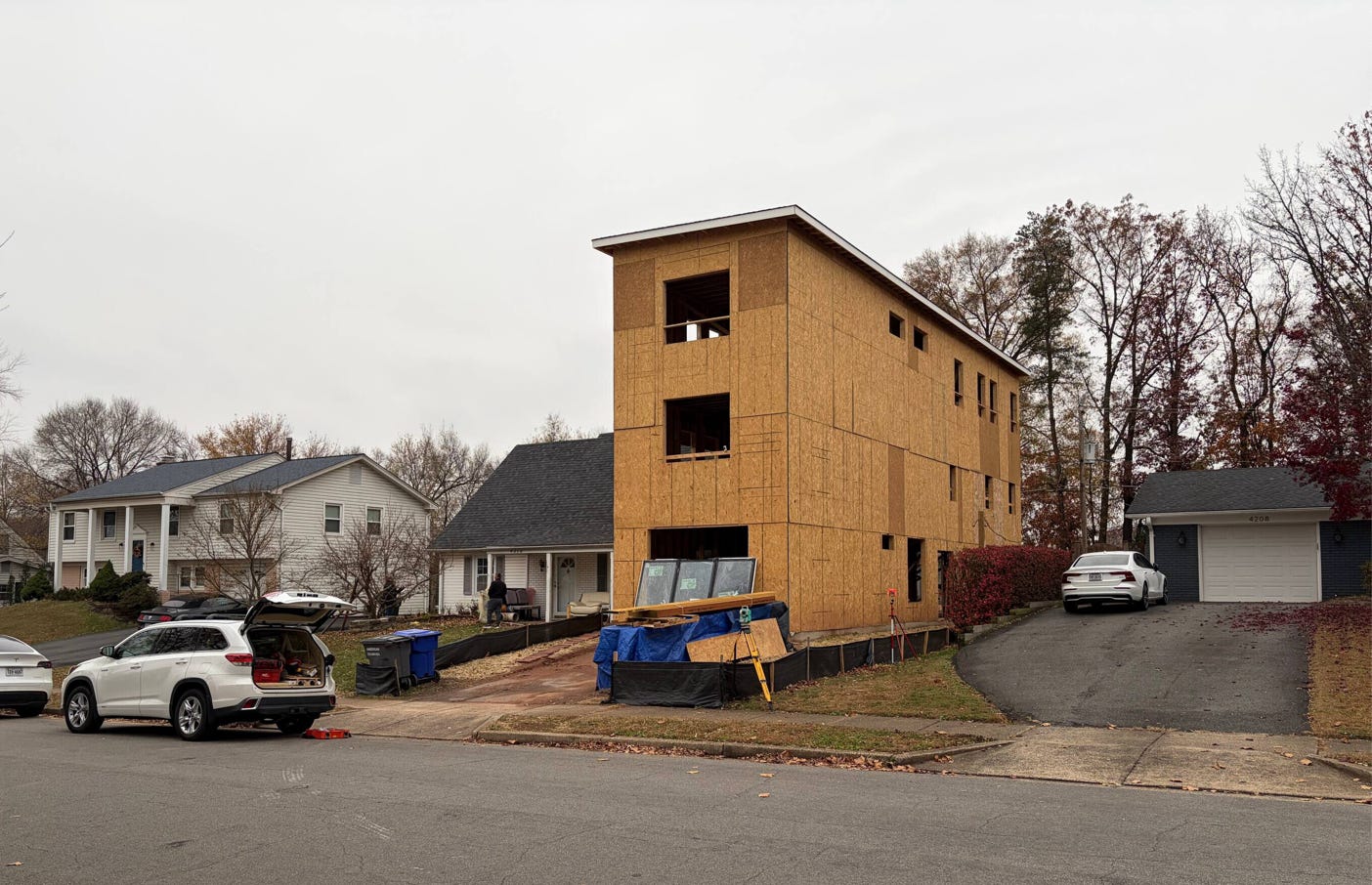
In the small neighborhood of Greenbriar, in Fairfax County, Virginia, the neighbors of Marble Lane are at war with each other. The cause? One neighbor’s three-story, 5,400-square-foot “hulking” addition to his 2,000-square-foot house—totally legal under county building codes.1 Meant to create more living space for the homeowner’s young family and his elderly parents, the project has ruined years-long neighborly relationships while fomenting public backlash, scathing media coverage, and official action. The immediate next-door neighbor laments that it “clearly diminishes my property and quality of life.” In this 1960s-vintage neighborhood of mostly one- and two-story homes, the addition is proportionally and aesthetically out of context with, indeed, the neighborhood character.
It’s tempting to say that this story is just another reminder that NIMBYism is everywhere, but two new research papers suggest that what’s happening in Greenbriar is a natural, predictable response. People simply don’t like buildings that don’t fit in.
Much of the prior literature investigating opposition to new development has highlighted the economic self-interest of homeowners—the so-called “homevoter” hypothesis—and neighborhood concerns about feared nuisances brought on by new development, like traffic, noise, or loss of trees—generally bucketed under “NIMBYism.” While both are meaningful, the new studies suggest that a third variable—neighborhood “fit”—is a more reliable predictor of opposition. The research shows that fit is not a minor aesthetic quibble. Nor is it merely a polite cover for deeper class or racial anxieties, even if those concerns sometimes accompany development debates.
One study, by Pietrzak & Mendelberg, finds that people react negatively when a building is architecturally out of place relative to the height or style of nearby buildings. Interestingly, “fit” matters more than height itself: a taller building that matches its surroundings is often more acceptable than a shorter one that doesn’t. People have “contextual development preferences,” and their reactions are shared among urbanites and suburbanites, homeowners and renters, across political affiliation, race, and age. Crucially, the researchers also find that contextual mismatches predict costly political action. The more a building doesn’t fit in, the more likely it is to mobilize political opposition among high-propensity voters to attend public meetings, pressure officials, or organize neighbors. Support rarely mobilizes, an asymmetry that explains why public hearings skew towards opponents of upzonings.
If Pietrzak & Mendelberg explain why mismatched buildings trigger opposition locally, a second study by Broockman, Elmendorf, and Kalla explains how people project their aesthetic preferences far beyond their immediate neighborhood.
Broockman et al. find that support for or opposition to new housing is shaped by aesthetic judgments: people have strong beliefs about what neighborhoods and cities “should” look like, particularly around building height and style. They find that people who live in low-density places like the suburbs tend to dislike density everywhere, while those who live in denser urban environments tend to be more broadly supportive of densification. In both suburbs and cities, among homeowners and renters alike, the researchers find that the ugliness of a building reduces support, even if it poses no threat to quality of life. These aesthetic judgments outweigh other policy considerations like affordability, environmental concerns, or fiscal costs. Further, these preferences are “sociotropic”: people universalize their own aesthetic tastes and seek to enforce them politically beyond their own neighborhoods in the name of the public good—even if people elsewhere do not share their preferences.
This matters—not only for Greenbriar, but for the broader landscape of land-use policy reform, which must account for this dual logic of local contextual “fit” and broader sociotropic judgments.
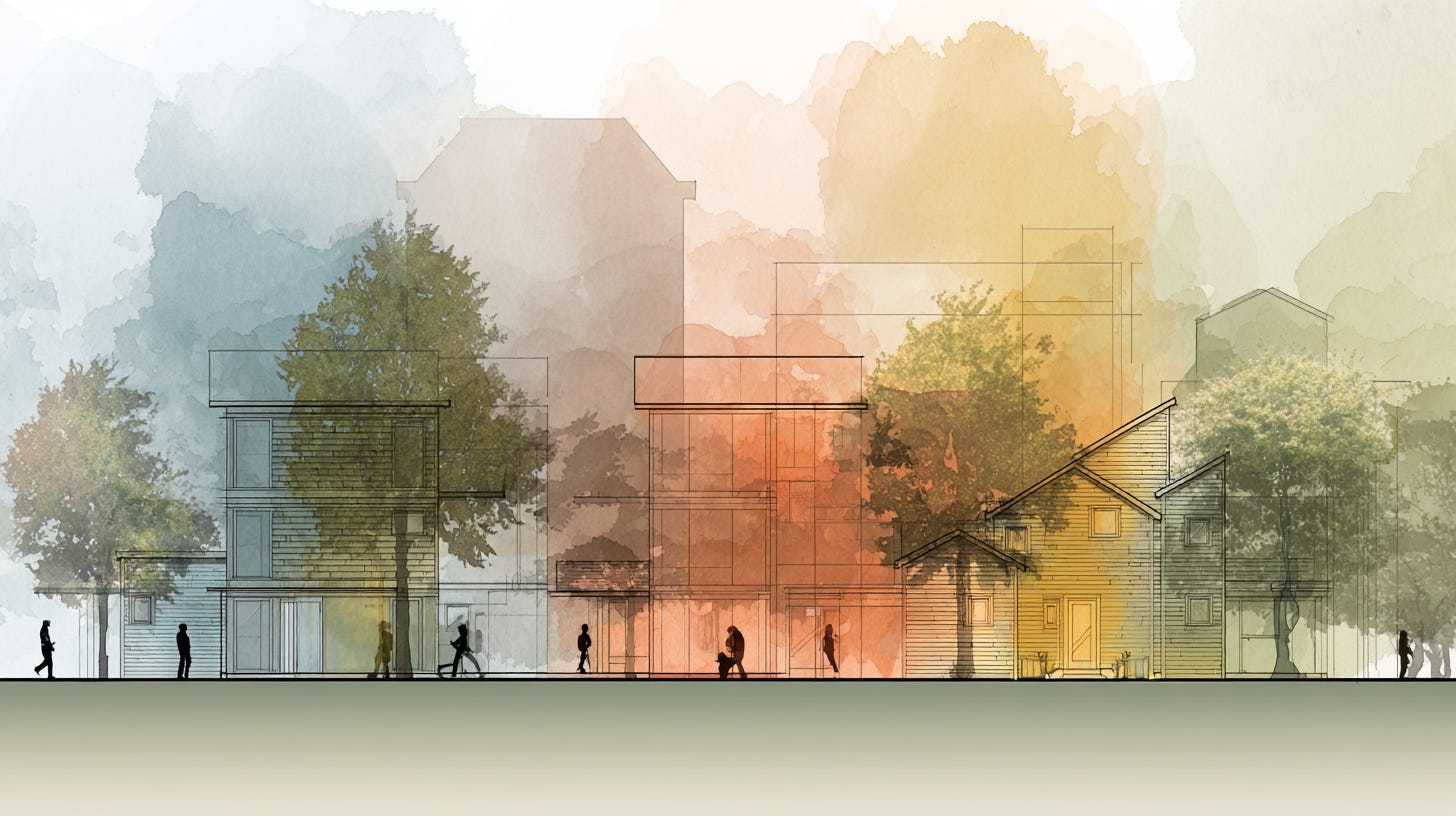
One implication is that incremental, context-sensitive reforms are likely to generate less backlash, while practical arguments about the benefits of new housing for affordability, homelessness, or environmental impact are not as persuasive as aesthetic heuristics. Another is that, because people self-select into areas of higher or lower density, geographic polarization around upzoning is almost inevitable. The deeper takeaway is that public opinion about development is downstream of land-use law, not the other way around: exclusionary zoning created the built form, the built form then created expectations, and those expectations now drive opposition to anything that departs from them. Within such a system, residents’ reactions are not irrational; opposition is a predictable product of the system itself.
In short, the aesthetics people now defend were manufactured by zoning regulation—and that same regulatory framework continues to reinforce the expectations it created.
Overcoming entrenched, self-reinforcing opposition nevertheless means working within the constraints of that system. Broockman et al. argue that the “housing shortage afflicting America requires policy solutions that grapple with political reality”—and that includes understanding and accepting that aesthetic preferences are legitimate and sincere, and therefore “meaningfully constrain political feasibility.” The question, then, is how to design housing policy that accommodates these preferences without allowing them to become an absolute veto on necessary reform.
To that end, Broockman et al. propose several policy prescriptions to align new housing with prevailing aesthetic expectations, including: (1) citizen-selected pre-approved apartment designs that emphasize familiar architectural forms, similar to pattern books for other housing typologies; (2) concentrating new height and density in already-dense districts where people expect it; and (3) enabling entire blocks to transact together with developers to avoid disjointed, piecemeal neighborhood transitions. The logic behind these proposals is simple: incremental, predictable change feels more acceptable than abrupt, anomalous change.
This aligns with Andrew Burleson’s argument that cities should allow the “next increment” of development rather than leaping to more aggressive upzonings. While I have argued that some urban areas require more than incremental reform, the approach makes a lot of sense in low-density, suburban contexts—including much of Austin, which recently legalized three homes per lot in single-family zones across the city, while limiting total bulk. At the same time, Austin increased density and height along commercial corridors—changes that drew opposition but also, for the first time, significant public support. Such reforms allow new development to better fit into its surroundings, reducing the visual shock. However, a drawback to an incrementalist, contextualist approach is that already-dense places would have to bear the entire burden of regional housing densification, while many central neighborhoods that would be denser if not for downzonings would remain untouched. As Pietrzak & Mendelberg note, such an approach may ease adoption but may also be too modest to address structural shortages.
Pietrzak & Mendelberg also find overwhelming support for policies that preserve neighborhood context: 84 percent favored “contextual zoning,” and 82 percent supported historic districting. But they caution that such policies often restrict new development and create exclusive enclaves. For instance, historic districts in places like New York City have contributed to affordability crises and entrenched segregation. They warn against broad downzonings or overly deterministic design rules that manufacture uniformity and perpetuate conformity. They are also wary of rules that prescribe aesthetic standards and traditional materials that may help new buildings “fit,” since these also raise construction costs and reduce the number of potential homes.
And that’s the crux of the problem.
Greenbriar is ultimately a story about the housing shortage. The homeowner built the addition as a long-term alternative to costly elder care, reflecting his family’s preference for multigenerational living. County officials are now looking to rewrite mass and bulk rules to prevent repeats of the Marble Lane conflict. Whether they will address the underlying issue—the need for more homes where people want them—is far less clear. Would a reform like Austin’s, allowing smaller but more units per lot, offer a contextual, incremental path? Could ADU reforms more flexibly accommodate multigenerational living or aging in place, as well? Or will the county clamp down on families trying to make home work as their needs evolve?
This points to a deeper tension: even with better design standards, the homeowner’s goals would still have clashed with neighborhood expectations. In the single-family suburb, the prevailing assumption is that each house contains one nuclear family; when household structures change, the expectation is that the family adjusts, often by moving out—the neighborhood stays the same. Any policy limited to single-family use ultimately reinforces one preferred family structure—and the aesthetic expectations built around it.
Greenbriar is not an outlier; it reveals how the aesthetic expectations enforced by exclusionary zoning play out in practice. Recognizing these expectations is essential, but it doesn’t mean we must defer to them in perpetuity. If aesthetic norms can be learned, they can be updated; if the built environment shaped today’s reactions, a different pattern of housing could shape tomorrow’s. Deference to context may be politically useful, but it cannot be the ceiling on what cities and suburbs allow. Ultimately, we need to imagine something beyond a system built for permanent aesthetic stasis—because when we keep form fixed, we force families to conform when they instead need room to flourish.
Complicating matters, the contractor (and city inspectors) appear to have mismeasured the distance from the neighboring lot line by roughly half a foot. Construction is now halted, and the owner—already $400,000 into the project—must seek a variance from the zoning board.
Oh man.
I started off this article rolling my eyes at the neighbors who of course hate anyone building any addition on their lot. And then I thought, well, 5,400 added square feet is rather a lot. And then I saw the picture and thought "oh no, I would be bothered by that, too!"
I definitely lean libertarian, and for the most part think that people should be allowed to build what they want on the property they own. But I also think, it's not surprising that visually jarring projects generate backlash, and the political consequences of backlash are kind of a big deal.
Your closing thought hits the nail perfectly: we need a system that doesn't require permanent aesthetic stasis. I think the really hard part -- but also the exciting work of our time! -- is to figure out how to get to such a system *from where we are today.*
I do think the most important outcome is that we get to a new pattern of dynamism and normalize the idea that buildings will change over time. That might mean some unsatisfying political compromises, like allowing change broadly but only in smaller increments, or even tolerating small pockets of a city to opting-out in order to move the rest of the city forward (as in Houston). But if we succeed in changing from "default static" to "default dynamic," then in time we'll achieve an abundance of neighborhoods that support human flourishing.
Great article, Ryan!
Great article. Exclusionary zoning is a self-perpetuating process. Stagnant neighborhoods create expectations that the neighborhood will never change in the future, creating more Nimbyism.
But yea, that picture of the house addition is a bit much. Change is important, but so is scale and massing.